|
Getting your Trinity Audio player ready...
|
In order to improve our lives and protect ourselves from threats, it is important to deeply understand the system in which we exist. What forces operate in it? How are they managed? What influences us from the inside and from the outside?
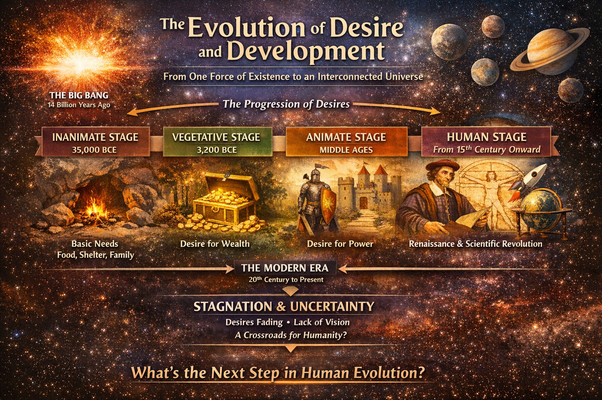
The universe is the largest system in which we evolve. A vast space filled with various bodies, stars, planets, and galaxies. According to what we have discovered, this began developing about 14 billion years ago from some small spark of force. This force can be defined as a desire to sustain itself, a desire to exist, which gradually multiplied.
Matter in the form of the inanimate is characterized by a desire to preserve itself and does not essentially need anything from the outside. It “enjoys,” so to speak, existing as it is. For example, if we take iron or water and want to change them, we must apply force to them. If nothing influenced them, they would remain in their form forever.
Later the vegetative level developed. The desire to exist in plants already wants to receive more advanced forms, to absorb influences from outside that appear beneficial, and to release substances that disturb it. This is a more developed desire than that of the inanimate. It is a desire willing to change, and which actually sees progress through change.
Since nature began developing from a single force, a single desire, it continues to remain interconnected in all its parts. What one element of nature senses as harmful and expels, another element senses as beneficial and takes for itself. This is how everything is connected. All parts of nature exist in a cycle of absorption and emission within one integral mechanism.
In the animal world, single-celled organisms first developed. Later they “discovered” that it was better to connect with one another, and multicellular creatures emerged. Cells took on different roles, cooperated with one another, and different bodies developed according to environmental conditions. This is why we see, for instance, brown bears, black bears, polar bears, pandas, and so on.
The desire of animals is at a higher level than that of plants, and therefore we see them move and change locations. In every living cell, alongside the desire to exist well, intellect also develops, a brain, a special program for managing itself. Memory of past events, development of plans for the future, and examination of which direction and form of development will lead to a better state.
In general, four stages of thinking can be identified developing within desire: perception, comparison, conclusion, and feedback. This is expressed, for example, in the way each creature knows how to build a dwelling in the ground or in a tree, how to reproduce, and how to guard its territory.
Human beings belong physically to the animal world, but their desire has developed to a higher level, and their intellect has developed along with it. It is important to note that a human being’s dependence on their environment is extremely strong. If, for example, a child grows up in the forest among animals, they will become like them, while if they grow up in a certain society, they will develop accordingly.
From a broader perspective, human development can be divided into internal stages corresponding to the inanimate, vegetative, animate, and human levels.
The first period began around 35,000 BCE and can be defined as the inanimate stage in human development. Human desires were basic, at the level of food, sex, family, and shelter. Around 3,200 BCE the vegetative stage began, in which the dominant desire was the desire for wealth. Later came the Middle Ages, from about the year 500 until roughly the 15th century. This was the animate stage, in which the dominant desire was the desire for power. From the 15th century onward began the stage of development of the human within the human, where the dominant desire was the desire for knowledge. This desire expressed itself in the drive to discover continents, develop science and technology. It was the time of the Renaissance. The individual personality of the human being began to stand out, and people began to see themselves as the center of reality. The twentieth century brought tremendous breakthroughs. For instance, Einstein, the theory of relativity, nuclear energy, mass communication, the internet revolution, and much more.
Since the end of the twentieth century, however, a decline has been felt, a kind of slowdown and stagnation. It is as though we have reached the end of evolution of the very point from which everything began. The feeling is that we have nowhere left to develop, as if the desire to grow has disappeared. In the past there were always people who initiated revolutions and new developments. There were opposing views that struggled with one another and helped clarify what was right for us and what was less so. In recent years, however, all these voices seem to have fallen silent. No one has great plans or illuminating goals, not to mention a compelling vision. Desires are fading, and people can barely find the energy to carry themselves through the day.
We do not see anything ahead of us. Humanity has never been in such a state before, and this is a very special stage of development. From here we will have to think together: what entirely new development can emerge from this dead end?
Based on “New Life 115 – Integral Course, Part 1” with Kabbalist Dr. Michael Laitman. Written/edited by students of Kabbalist Dr. Michael Laitman.
Posted on Facebook, Instagram, Medium, Twitter X, YouTube, Quora