When we speak about assimilation and intermarriage, we are touching on a very sensitive and, for many, painful issue. Statistics show that more than half of Jews who marry today choose partners outside the Jewish framework. This trend is not accidental, and it is not new. It is the natural result of a deeper process taking place within Jewish society and within humanity as a whole.
At first glance, this phenomenon might seem surprising. We could assume that a person would naturally prefer to marry someone from the same culture, with similar values, upbringing, and traditions. Yet reality shows otherwise. Many Jewish children today grow up immersed in the general culture. They attend the same schools as everyone else, share the same environment, lifestyle, and aspirations. From their perspective, there is little difference between themselves and others. On the contrary, if they do feel some kind of distinct relation to being Jewish, it can sometimes push them away, making them want to dissolve that difference rather than preserve it.
This means that by the time a young person reaches the age of marriage, the internal connection to their Jewishness is already very weak. The environment surrounding them does not provide enough warmth, meaning, or value to sustain a desire to remain within it. Occasional exposure, such as attending Hebrew school once a week, celebrating holidays, or participating in community events, is simply not enough to build a lasting identity. The results speak for themselves.
If we want to understand why assimilation is happening, we must first look honestly at the environment we are providing. A person is a product of their surroundings. If the environment does not give a strong sense that being Jewish is meaningful, valuable, and necessary, then there is no reason for the individual to hold on to it. Habits, values, and identity must be built continuously, from early childhood, through consistent education and lived experience. Without this, there is nothing to anchor a person within that identity.
However, the problem runs even deeper. The question is not only how we educate our children, but what we are educating them for. Why should a person remain Jewish? What is the benefit? What is the purpose? If neither the parents nor the children can answer this question, then assimilation becomes not a problem, but a natural outcome.
Historically, what kept the Jewish people together was not a positive force, but a negative one. External pressure, rejection, and antisemitism prevented Jews from assimilating. They had nowhere to escape their identity, so they remained within it. But today, in many parts of the world, this pressure has weakened or taken different forms, and the internal foundation that should replace it has not been established.
In truth, there is no inherent reason, from a purely worldly perspective, to remain Jewish. If a person looks at life only through the lens of personal comfort and social integration, then assimilation is the simplest and most logical choice. This is why the current trend is so widespread and why it will continue to grow.
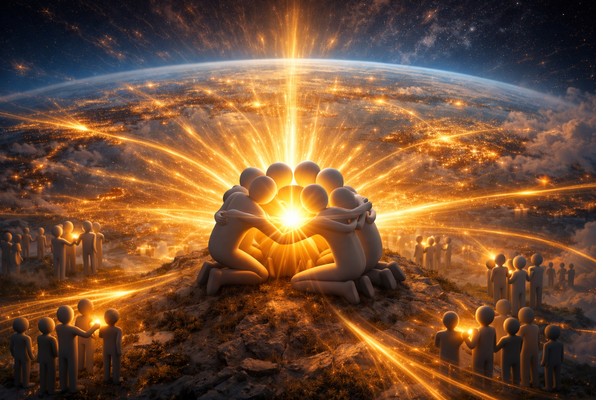
The only way to address this issue is to return to the root, to reignite what it truly means to be Jewish. According to the wisdom of Kabbalah, being Jewish is not a matter of culture, religion, or ethnicity. It is a role, a function within humanity. The Jewish people originated from a group that united around a spiritual principle, that of unity above division, connection above egoism, which is expressed in the rule “love your neighbor as yourself.” This unity allowed them to discover the positive force dwelling in nature, a force of love, bestowal, and connection.
Their role, from the beginning, was to serve as a conduit for this force, i.e., to bring it to humanity. This is what is meant by being “a light unto the nations.” It is not a slogan, but a function within the system of human development.
Today, humanity is rapidly accumulating problems on all scales, personal, social, economic, and ecological, as we encounter a state of increasing interdependence combined with growing division and confusion. The world subconsciously expects a solution, a method of connection that can resolve these problems. This expectation is directed toward the Jewish people, even if neither side fully understands it. This is the deeper root of antisemitism and of the pressure felt toward Jews throughout history.
If we explain this role clearly to ourselves and to our children, then being Jewish acquires a deep meaning. It becomes not a burden or an outdated identity, but a responsibility and an opportunity. A young person who understands that they are part of a process that affects all of humanity, that they carry a method that can help resolve the global crisis, will relate to their identity differently. They will feel pride, purpose, and connection.
However, for this to happen, education must change. It must move beyond rituals and occasional exposure and address the essence: the purpose of the Jewish people, the process humanity is undergoing, and the role each individual has within it. This education must be continuous, impactful, and alive, both at home and in society.
The problem of assimilation is therefore not about intermarriage itself, but about the absence of a meaning that drives and inspires. When there is no clear reason to remain Jewish, assimilation becomes inevitable. When that reason becomes revealed and felt, the situation changes.
Therefore, the solution is not in restrictions or external pressure, but in understanding. Both parents and children must learn what it truly means to be Jewish. Then, people can make a conscious choice to remain connected, not out of its negative form of habit or fear, but out of its positive form, that of a shared purpose and role.
Based on the video “Jewish Assimilation – Jtimes with Kabbalist Dr. Michael Laitman.” Written/edited by students of Kabbalist Dr. Michael Laitman.
Posted on Facebook, Medium, Quora, The Times of Israel, Twitter X, YouTube