|
Getting your Trinity Audio player ready...
|
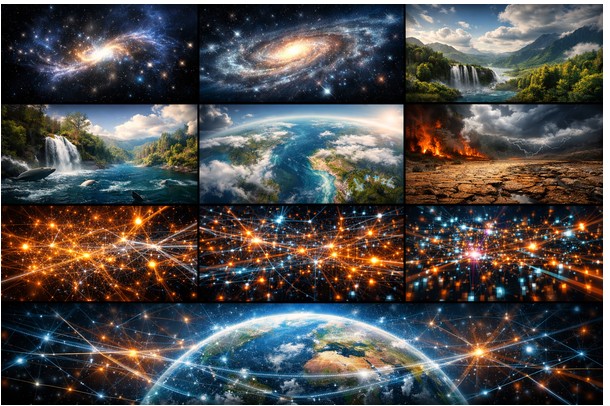
Why did language evolve in human society? What was it meant to complete? Also, why are people today increasingly unable to understand one another?
All of nature is founded on a basic driving force, the desire to exist well, to fulfill what is felt as lacking, to receive satisfaction and pleasure, to enjoy. From this arise all the connections between elements in the universe.
When we observe movement somewhere, it is the result of communication between bodies, forces, fields, and other factors we do not yet fully understand. This takes place at the inanimate level, for example in the interaction between planets. At the vegetative level, communication is stronger, such as through physical contact between plants and tree roots. At the animate level, we see extensive communication through scents, movements, signals, and sounds. Evolution is communication, connections, and their purpose is to provide each element with what it needs for its existence. Without communication between different elements and levels—inanimate, vegetative, and animate—there is no life or evolution. Communication leads to various forms of systemic complementarity, and nature evolves as a single integral mechanism.
Human beings emerged from the animate world, and as their desire grew to absorb the entire world for their own enjoyment, they became disconnected from the system of nature. Humans turned into harmful creatures that do whatever they feel like in the moment, without consideration. The intensification of the egoistic desire in humans led to the loss of the instinctive ability to connect in a balanced and harmonious manner with the other parts of nature, which every other creature has. As a result of this loss of communication with nature, humans no longer feel or understand it.
Here and there, one can still see examples of people who live in nature, for instance in remote jungles. For them, the forest is a language. Through the sounds of animals, the scents of plants, the state of the air, the sky, the ground, and other information sources in nature, they receive information about the world and how it relates to them. They feel how the divinity within nature speaks to them.
As people move away from nature, even into village life, they become more distant from it and less dependent on it. They have sheep, a plot of land, and begin to organize systems of trade and commerce, conducting business, and so on. Accordingly, language shifts from an integral and mutual form to a language of receiving, profiting, and exploiting.
Unlike every element in the inanimate, vegetative, and animate levels, which takes from the system only what it needs and thereby contributes to overall balance, the human being, having disconnected from nature, no longer receives from it the “program” for a balanced and harmonious connection. Instead, humans act mainly according to egoistic impulses that grow stronger, and which damage everything and everyone around them. They lack a language of complete connection with nature, a direct and open channel without limitation. Their perception narrows to what is most self-serving at every given moment.
Therefore, a reality emerged in which the successful are those who know how to exploit others more cleverly. Laws were then created to try to limit the harm, to define boundaries beyond which exploitation becomes illegal. Social agreements formed to set limits on interactions, to define what is permitted and forbidden, and so on.
From a broader perspective, our lives are studies in communication and language. Educators try to teach how to relate properly to others and to society, and scientists also attempt to understand how to connect correctly with the environment. Had we not descended from the trees, we would not need to learn communication. Language came to compensate for the sense of connection we lost among each other and with nature. In culture, art, music, dance, song, theater, and literature, everything is language, the transmission of emotion.
Up until about five thousand years ago, language was very simple. There were not many phenomena people needed to describe, explain, record, or pass on to future generations. Vocabulary was limited, and so was language itself. Then, in the region of Mesopotamia, the cradle of human civilization, there emerged a significant surge of ego. In other words, the desire to enjoy for self-benefit at the expense of others immensely grew. It created internal distance between people and caused them to stop understanding one another. From there, they spread in all directions, and different languages developed.
As the internal distance between people grew, yet the need to maintain connection remained, language evolved. Trade, economics, caravans carrying goods, all are forms of communication and transmission. Even the wars and conquests throughout history stemmed from the desire to spread a certain worldview or ideology.
Today, on one hand, there is abundance and remarkable technology. On the other hand, relationships are terrible. At its core, this is a crisis of communication, a crisis of language. Precisely in an era when the world has become one small global village, we have lost the ability to understand one another. This is the case at home, work, in society, and within nations, and certainly across humanity as a whole. Violence and intolerance are on the rise, corruption is reaching new heights, the economy creates ever larger bubbles each year, nuclear war looms at a frightening pace, and the ecological state, i.e., what we have done to the environment, is painful to see.
From here, there is only one way out, and it requires learning a new language. Hints of this appear in the story of the Tower of Babel, the tower of human egoism. When people stopped understanding each other’s language, Abraham of Babylon came and spoke of the language of kindness, the formula for complementary communication. Kindness means opening ourselves up to one another, each person to all, with the desire to pass on all that is good between us, from person to person. Such a desire connects everyone in love, makes us “as one man with one heart,” and enables a harmonious flow.
This unified place is where our evolution has been leading us, from the beginning until now. As we move toward it consciously and by choice, we will again begin to feel the system of nature, the higher force that pushes us to higher awareness. This will bring us to a completely new level of connection with all of creation, providing answers to who we are and why we exist.
Based on “New Life 129 – The Development of Language” with Kabbalist Dr. Michael Laitman. Written/edited by students of Kabbalist Dr. Michael Laitman.
Posted on Facebook, Instagram, LinkedIn, Medium, Quora, Twitter X, YouTube