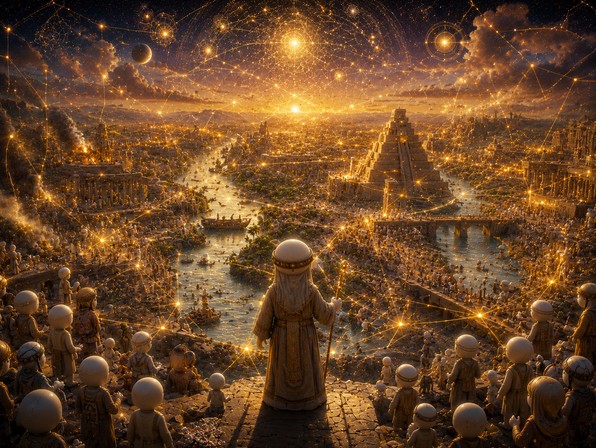
Mesopotamia, the cradle of modern civilization, also known as “the land between two rivers,” was a vast and fertile region situated between the Euphrates and Tigris Rivers, in present-day Iraq. Mesopotamia was the birthplace of many inventions that enabled human civilization to develop. It bore the invention of the wheel, the advancement of mathematics and astronomy, and the initial cultivation of grain crops that remain staple foods to this day. It was also the birthplace of a man named Abraham.
Up until that time, the atmosphere in Mesopotamia had been relatively peaceful. As the Bible describes it, “The whole earth was of one language and of one speech” (Genesis 11:1). People felt close to one another, like one large family. Then suddenly, each person’s ego—the desire to enjoy at the expense of others—began to grow rapidly, as symbolized by the story of the Tower of Babel. This saw the emergence of destructive competition, harmful envy, power struggles, exploitation, and hatred.
Abraham studied what was happening and understood that humanity was facing a critical test: Would people realize that they must rise above narrow egoism and build harmonious relationships with one another, or would they choose to separate? He tried to explain that nature is unified, that life develops through connection and harmony between opposites, and that human beings must also learn to live in peace with each other. However, most people were not ready to grasp the idea of universal unity. They chose to break apart, dispersing from that region across the entire world.
Abraham, however, saw further ahead. He understood that dispersal was no solution to the crisis in human relationships, but merely a postponement of it. Indeed, today we have arrived at the same point once again. The network of connections that has formed throughout humanity has placed us all in the same boat. Whether we like it or not, we depend on one another, yet with the enormous ego that has developed within each of us, we do not know how to get along. Unlike ancient Babylon, however, this time there is nowhere left to scatter. To survive, we will be compelled to learn how to connect.
Abraham’s campaign of explanation was not overwhelmingly successful, but several thousand people nevertheless gathered to study his method. In time, this community of students became the people of Israel, as described by Maimonides in The Book of Knowledge.
Abraham taught that “the inclination of man’s heart is evil from his youth,” meaning that narrow egoism is embedded in us. Yet through the effort to overcome it, we can elevate ourselves to a force higher than it. A “higher force,” then, is not something beyond the stars, nor some mystical entity in another dimension. Rather, it is a force higher than the ego, a force capable of governing it.
What distinguished Abraham’s group from everyone else was an inner feeling that life has a higher purpose than simply achieving material success. Material well-being is important, but it is not enough. In other words, a desire grew within people to discover the secret of life beyond what was materially visible.
Abraham taught them that the egoistic force is natural. Through it, we feel rejection toward anyone or anything that might harm us, and attraction toward anyone or anything that might benefit us or provide pleasure. Even when we love someone and wish to be close to them, it is still based on egoistic calculations, whether conscious or unconscious. Does any force exist other than the egoistic one? In the still, vegetative, animate, and human levels of nature, we do not see one. Even the interactions between atoms and molecules are driven by natural self-serving forces that seek completion, balance, and stability.
Yet nearly six thousand years ago, a desire began to emerge in certain individuals to discover another force beyond the egoistic one, a force of pure giving that is nonexistent within our ordinary world. These individuals developed to a more advanced level of perception called “spiritual perception.” Abraham followed in their path, but what distinguished him from those before him was that a broad social crisis erupted during his time.
Abraham explained that if we learn to build positive connection above the ego, we will discover a higher force within the bonds between us, a force of love and bestowal. These qualities would be genuine, not because our egos derive pleasure from them, but because we would actually live within that new force. That is how we could construct a new system of relationships among ourselves, an integral network. When that network reached balance, we would begin to feel within it something called “the source of life,” the single force underlying nature, from which we came and toward which we are drawn.
After Abraham’s students began working on their connection and rose somewhat to the level of spiritual existence, the separating egoistic force among them also grew. They experienced eruptions of mutual hatred and were required to overcome them with an even greater force of love and bestowal. Thus they advanced at every stage of their development according to the principle of “Love covers all transgressions.” Eventually, however, their positive ties became ruptured in a state of destruction. Great hatred broke out among them, and they no longer possessed the strength to cover it with love. The ego took control, and the people of Israel went into exile among the nations of the world.
Today, the circle has closed, and we have returned here. We are the descendants of Abraham’s group, and we must rebuild ourselves from the state of destruction. We must once again learn his method of connection above the ego and lead the process of repairing the world. The dismal state of relationships—from the interpersonal level to the level of nations and humanity as a whole—proves that there is no alternative: positive connection above all divisiveness is our sole salvation.
Based on “New Life 147 – Journeying to the Roots, Part 1” with Kabbalist Dr. Michael Laitman. Written/edited by students of Kabbalist Dr. Michael Laitman.
Posted on Facebook, Instagram, Medium, Quora, The Times of Israel, Twitter X, YouTube