|
Getting your Trinity Audio player ready...
|
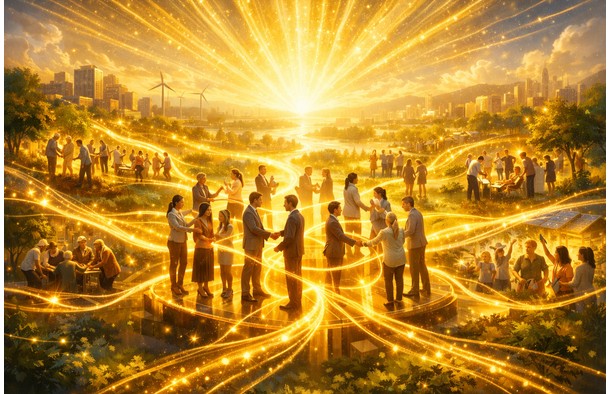
Reality is placing all of us in the same boat. As we increasingly discover how dependent we are on each other, tensions and pressures grow. This harms our health, mood, and relationships, whether at home, in the workplace, and at large in our countries of residence. What changes should organizations lead in order to adapt to the emerging conditions?
Let us begin with the bottom line. If everyone in the organization is positively connected through complementary integral relationships, we will certainly be stronger, more efficient, more successful, more satisfied, happier, and more fulfilled. Moreover, such connection will align us with the general system of nature, the global and integral mechanism in which all parts complement the fabric of life. This alignment will radiate a positive force upon us, both as individuals and as a society.
To achieve these benefits, we must create an environment within the organization that is based on integral values. In other words, we should turn our workplace into a shared asset that we build through connection, cooperation, responsibility, and mutual guarantee. The integral approach to education teaches how to do this and can serve as our guide.
The positive environment we create in the organization will influence not only our work but also our families and our leisure lives. The organization will transform from a place where we merely work into a place where we live together with a positive feeling. Our families will also enjoy the new spirit of connection and positive relationships. Gradually, the organization will become like one large family that includes all the families of its members and helps them cope with life’s challenges. We will organize picnics, trips, celebrations, clubs, summer camps, and workshops together. We will become something like a warm and embracing tribe where no one feels alone. We will help each other, care for one another’s well-being, and feel that we truly belong together.
So how do we do this? Where do we begin?
The integral approach to education is based on the study of human nature, the nature of the world, and the integral direction of development in which we exist.
In this process we will together explore how we are built. For example, research shows that people prefer to receive a lower salary as long as it is higher than that of others, instead of a higher salary if others receive more than they do. What leads people to make such decisions? Why do people measure their success in comparison with others?
Beyond this, why does a person tend to step on others in pursuit of personal achievements?
What is the structure of the human being’s egoistic nature? What is good about it, and what is harmful? What do we lose because of destructive competition? Could there be another type of competition, one that benefits us all?
Imagine, even for a moment, that a person were as happy about a colleague’s success as they are about the success of their own child. What would our lives look like then? How much would the boundaries of our enjoyment expand?
Moreover, regarding the development we undergo from one generation to the next. What distinguishes people of earlier generations from people today? How has their ego developed? What forms have relationships taken between individuals and those around them? What has happened to relationships between spouses, between parents and children, between workers, between organizations, between sectors, and between nations and societies?
On one hand, reality has become increasingly interconnected and interdependence has intensified. On the other hand, the ego of each individual has grown enormously, and it continues to grow. Where will this lead us in terms of processes, trends, and threats?
Also, what happens in the natural world around us? How does the general force of nature cause opposites to complement one another in order to sustain the development of life? Why does it not guide us humans in the same way? Why are we not instinctively programmed like animals or plants? Why is everything with us so complicated?
Through such explorations we gradually arrive at a common understanding. On one hand, the ego has brought humanity to a very high level of development, but on the other hand, today it must be adapted to the new environmental conditions. In today’s interconnected world, it is impossible to consider only oneself, because such behavior will ultimately cause everyone to sink.
From this realization it becomes clear that the best course of action is to build an integral environment in the organization, a positive environment that will already today reflect the values of the connected world toward which humanity will inevitably move tomorrow. This will place us on a path of success, making us a model for others and a source of inspiration.
There are many ways to build an integral environment. The guiding principle is a common effort to think about the benefit of everyone together, not of each individual separately. At every moment and in every action, each person should try to set a positive example. For instance, turning off lights and air conditioning when they are not needed, taking care of the organization’s equipment, smiling, offering compliments, occasionally giving small gifts to others, and similar gestures.
It is also very important to work on uplifting the general atmosphere. Music that people enjoy and songs that warm the heart can be played in the background. A short morning meeting can be held where rotating “connection hosts” greet everyone at the start of the day and remind them that the most important thing is to maintain a positive atmosphere, good relationships, and mutual help and support, to feel that we are all one family. Someone might arrive in a bad mood or encounter difficulties during the day, but we are all here to strengthen and uplift one another and to give warmth and care. It is possible to share good news about the organization or about society in general. Each time someone different can be praised for contributing to the positive atmosphere. Perhaps even a short connection workshop can be held. If a similar gathering takes place during lunch or at the end of the day, that is even better.
As the organization becomes a positive environment, a warm and united tribe, people will stop trying to undermine one another in order to rise at others’ expense. Instead, everyone will support everyone else. Each person will feel surrounded by warmth and care, which will awaken a desire to realize their full potential for the benefit of the organization and society. There will be no place for laziness, disregard, or minimal effort. Naturally, this will also be reflected in the organization’s results, and it is worthwhile for the organization to share part of the growing profits with everyone.
The successful organization of the future world will be integral and connected.
Based on “New Life 119 – Benefits of Interconnectedness” with Kabbalist Dr. Michael Laitman. Written/edited by students of Kabbalist Dr. Michael Laitman
Posted on Facebook, Instagram, LinkedIn, Medium, Twitter X, YouTube, Quora