|
Getting your Trinity Audio player ready...
|
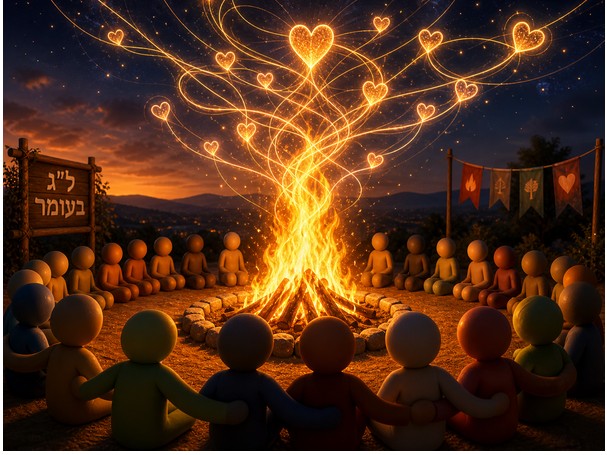
Lag BaOmer marks a very special point in the spiritual development of a person and of humanity as a whole. To understand it, we need to see the broader process that creation undergoes.
The purpose of creation is to benefit the created beings. From this intention unfolds the entire spiritual system of the worlds, their shattering, and their correction. The soul of Adam HaRishon was also created, expanded, and shattered. This was all done so that we, from within the shattered state, would consciously return to a corrected state. By gathering the soul’s shattered parts, within us and between us, we come to understand creation, its Creator, and the entire process we undergo in our evolution. Moreover, we ultimately gain resemblance to the Creator, the upper force of love and bestowal.
In this process, there are two main paths. One is when we apply ourselves to connect, i.e., to gather the shattered pieces through our own desire. When we try to unite in mind and heart, we awaken a special force called “the reforming light,” which helps us connect in a harmonious manner. The other path is when we fail to positively connect in time according to the program of creation. Then that same upper force pushes us through pressures, problems, and suffering. This also brings us closer, but in a way that is undesirable.
Along this path, there are also special times, spiritual states that repeat cyclically called “holidays.” These are not simply calendar dates, but states of illumination that influence us and help guide us toward a corrected state of absolute harmonious and peaceful connection to one another as a single soul. Each holiday represents a particular stage in such a process of advancement.
The sequence begins with the exodus from Egypt, which symbolizes the exit from the human egoistic desire for self-benefit at the expense of others. Passover marks the beginning of freedom, where we acquire the ability to bestow for the sake of bestowal. After that begins the work of purification, the preparation of the vessels, our desires, for the reception of the Torah.
Lag BaOmer is a turning point in this process. It represents the completion of the correction of the vessels of bestowal. In spiritual terms, it is the end of the stage called “Katnut” (“infancy” or “smallness”), where we learn how to act in bestowal without yet receiving. Up to this point, we have corrected our desires in the form of bestowal for the sake of bestowal.
From Lag BaOmer onward begins a new stage, the correction of the vessels of reception, where we learn to receive in order to bestow. This is called the stage of “Gadlut” (“adulthood” or “greatness”). It is a higher and more complex level, where we begin to receive the upper light in corrected desires.
That is why Lag BaOmer is considered a festive point. Even though only part of the work is complete, in spirituality there is no partial correction. By correcting the vessels of bestowal, we already establish the foundation that guarantees we can reach full correction. It shows that we are capable of completing the process.
At the same time, this day reminds us of the importance of connection. The story of Rabbi Akiva’s students, who perished because they did not treat each other correctly, highlights that spiritual progress depends entirely on the quality of our relationships. Without mutual respect and unity, advancement is impossible.
Therefore, Lag BaOmer symbolizes both a completion and a transition. It is the boundary between two types of work, between learning to bestow and learning to receive correctly. It reminds us that from this point forth, even greater connection and dedication to one another are required.
Ultimately, all these stages lead to one goal: the reception of the Torah, not as a book, but as the light of wisdom that fills corrected desires. This is the state where creation reaches a corrected, harmonious, and peaceful state of unity.
Based on the Daily Kabbalah Lesson with Kabbalist Dr. Michael Laitman on May 2, 2018. Written/edited by students of Kabbalist Dr. Michael Laitman.