|
Getting your Trinity Audio player ready...
|
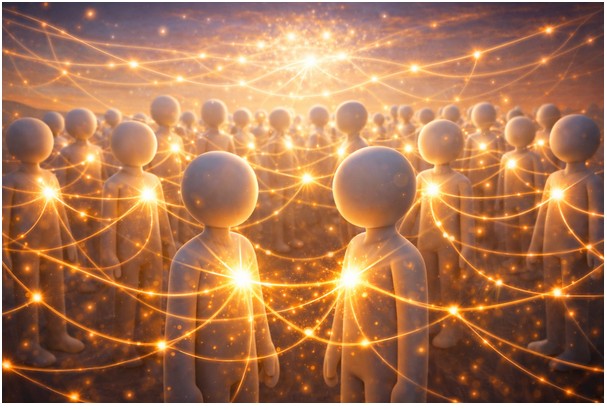
How much is our communication influenced by our sensory system? What exists around us now that we do not feel?
Trackers are highly skilled individuals who are trained to read subtle signs in the environment. They can detect footprints, disturbances in the ground, and other nearly invisible clues to identify dangers such as land mines or to follow movement across terrain. Their work requires an exceptional level of sensory awareness and attunement to nature, which reflects abilities that humans once possessed more broadly but have largely lost over time.
As we moved further away from nature, we lost the sharpness of our senses. Wine tasters, for example, also need to maintain acute senses. However, most of us no longer do. Since we left the animal world, we have built systems that let us survive even without highly refined senses.
Behind the sensory system stands human desire, the desire to exist well, to enjoy, and not to suffer. This desire activates the senses, directing them to find what is beneficial and what may be harmful. In addition, within this desire there is memory, which accumulates distinctions: genes, hormones, innate traits, as well as educational, social, and cultural influences. All of this together forms a highly subjective perception of reality in each person.
In such a reality, what kind of communication can we even speak of? Between whom and whom? After all, each person is built differently on the inside and perceives a different picture of the world through their senses. This is the root of all the communication problems we encounter.
Those who do understand the person in front of them well are salespeople. Their senses are extremely sharp. But selling is not communication in the sense of creating a mutual connection. Nor do the media outlets that flood us with their messaging serve the purpose of building positive human connections. Instead, they often sow division and inflame conflict.
Add to this the fact that nowadays we meet less face-to-face, communicating through screens, and we get a reality in which each person is becoming more and more distant. This is reflected in the collapse of the family unit and in the growing lack of desire to maintain relationships. Disconnection leads to isolation, then to despair, depression, and emptiness. There might be material abundance, but emotional fulfillment is increasingly lacking.
Simultaneously, the world we live in is becoming more and more interconnected. Everyone influences everyone and depends on everyone. This causes us to lose control over the systems we have built, such as the economy. If in the past there was an ideological struggle between communism and capitalism, today it is clear that neither leads to lasting peace or fulfillment. Moreover, if until now money clearly defined communication between you and me—how much I am worth, how much you are worth, and what kind of deal is worthwhile—today even that is breaking down.
If there were good communication among all of us, we could easily meet the basic needs of every person and every family. With the technologies we have developed, this is not a problem at all. But there is a general deteriorating trend in relationships. Our resources are aimed at defense and attack, and the threat of a nuclear world war has become routine.
Eventually, we will realize that we are all in the same boat, and we will have no choice but to learn how to get along, otherwise we will all sink. Then, the need for a new sense will arise: an integral sense. A sense that enables us to feel everyone as one, to perceive the world as a system whose parts are interconnected, equal, and important.
The communication we will need will also be fundamentally new, one that is integral, which connects people positively, and which brings people closer together, leading to deep emotional bonds. Accordingly, all forms of human connection will be upgraded. Culturally, artistically, and educationally, integral people will create integral works—music, songs, plays, films, series, games—aimed at developing a sense of connection and unity.
From an evolutionary perspective, this means that from the beginning of our existence on Earth, we have been driven by individual desire, the desire of each person to attain pleasure, enjoyment, comfort, satisfaction, and peace of mind. Every connection with others and with the environment has served this desire, issuing one command after another. Whether we approach or withdraw from someone, the calculation was always “What will come out of this for me, good or bad?” or, in another version, “How can I use you?”
Now we are advancing to a new level of perception—one composed of an integral desire for connection and complementarity, an integral sense that sees everyone as part of ourselves, and an integral, ideal, and complementary form of communication. The world that will become revealed is beyond anything we can currently imagine. I wish us all success on this path.
Based on “New Life 128 – Communication and the Sense System” with Kabbalist Dr. Michael Laitman. Written/edited by students of Kabbalist Dr. Michael Laitman.
Posted on Facebook, Instagram, LinkedIn, Medium, Twitter X, YouTube, Quora