|
Getting your Trinity Audio player ready...
|
One of the pressing questions I am often asked in response to great tragedies is this: If the Creator—a loving, caring, and bestowing force—governs everything, how can so many harsh and cruel events take place?
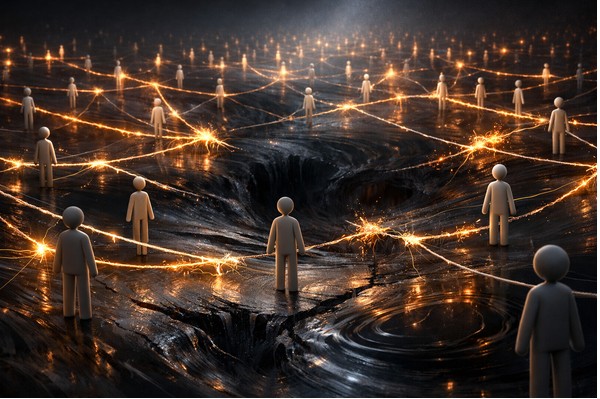
The answer lies in understanding that the Creator is not a personality acting with changing intentions, but a law, i.e., a fixed, unchanging system that operates in the connection between people. The Creator becomes revealed precisely in the quality of connection that exists among people. Therefore, everything depends on the state of that connection.
Humanity needs to gradually rebuild its harmonious, peaceful, and eternal connection as a single soul, which once existed, then shattered, and which we are now in a process of correcting this shattering until it becomes fully corrected. If we advance according to the required stages, then everything unfolds harmoniously. However, if we delay or resist this development, then we begin to feel the discrepancy between the state we are in and the state we are meant to reach.
This discrepancy is what we experience as pressure, problems, and suffering.
For example, if at a given moment humanity needed to reach a certain level of connection, say, twenty percent, but in reality we only achieved fifteen percent, then the missing five percent becomes disclosed as a negative force. This gap manifests as crises, tensions, and various forms of suffering that goad us to close the distance between the desired and the actual state.
These forces are not punishments. They are not expressions of a “good” or “bad” Creator. They are the operation of a law, a system that cannot be violated. Just as in any natural law, if we act in accordance with it, we feel harmony, and if we act against it, we feel imbalance.
Therefore, the question should not be whether the Creator is good or bad, but rather how these forces, whether pleasant or unpleasant, help us progress to the correct state.
From the perspective of the Creator, there is no intention to harm. There is only a law of nature. What is this law of nature? It is a law of perfect integral connection fueled by relations of love and bestowal in the midst of that connection. The degree by which we align ourselves with this law determines the degree by which we experience balance, fulfillment, and peace.
This understanding becomes especially important when we reflect on the most painful events in human history. For instance, today on Holocaust Remembrance Day, one might ask: did the Creator cause such suffering?
The answer is no. Human beings caused it through their failure to fulfill the conditions required of them. When humanity, and particularly the people of Israel in their role—to unite (“love your neighbor as yourself”) above the intensifying divisive drives (“love will cover all crimes”) in order to become a conduit for the unifying law of nature to spread globally (to be “a light unto the nations”)—failed to correct the connection between them to the degree required, the imbalance reached a level where it manifested as immense tragedy.
There are many sources that affirm this principle: the suffering is not imposed externally, but arises from the mismatch between what is required and what is realized.
If the conditions for an optimal harmonious and peaceful connection are known, yet not fulfilled, then we ourselves activate the forces that push us toward correction, sometimes in very harsh ways. These forces are simply the system acting to restore balance.
Throughout history, this pattern has repeated itself. From ancient Babylon, through Egypt, the desert, the periods of exile, and the ruin of the Temples, humanity has continually faced pressures that reflect its level of connection or disconnection.
The Holocaust represents a particularly acute example of this principle. It occurred at a stage when humanity, and specifically the people of Israel, reached a critical level in the development of the collective soul, a level requiring a much higher degree of unity. The failure to meet that requirement resulted in a correspondingly severe manifestation of imbalance.
And the same principle applies today.
The conditions for connection continue to increase. The demand to positively realize an increase of human connection becomes stronger with each stage of development. If we do not respond to this demand consciously and willingly, the system will still guide us toward it, but through pressure and suffering.
This leads to a crucial question: what should we do with this understanding?
The purpose of studying history is not to dwell on past suffering, but to learn how to avoid repeating it. If we recognize that reality operates according to a fixed law of connection, then our task becomes to actively work to strengthen the bonds between us in accordance with the level that becomes revealed at every moment.
Otherwise, the same pattern will continue. Just as crises repeated from Babylon to Egypt and beyond, they can repeat again—potentially in even more severe forms—if the required correction is not carried out.
Therefore, the responsibility lies with us. We are participants in a system governed by immutable laws. To the extent that we align with those laws, we experience harmony. To the extent that we do not, we experience the forces that compel us to realign.
The choice is not whether we will reach the goal of connection, but how we will reach it, either through conscious participation or through the pressures that arise from resisting it.
Based on the Daily Kabbalah Lesson with Kabbalist Dr. Michael Laitman on Holocaust Remembrance Day on May 2, 2019. Written/edited by students of Kabbalist Dr. Michael Laitman.
Posted on Facebook, Instagram, LinkedIn, Medium, Quora, The Times of Israel, Twitter X, YouTube