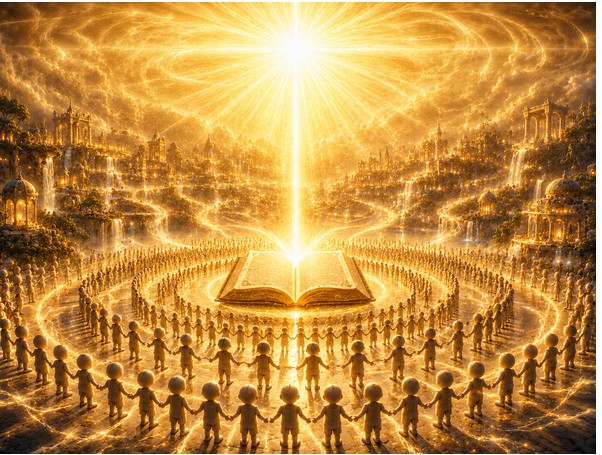
Indeed, The Book of Zohar is very special. It is the book of books of the wisdom of Kabbalah. A book that speaks entirely about the correction of the human being, about a corrected society whose network of connections is called “the soul.”
Everyone talks about the soul, but no one really knows what it is or where it is, if it exists at all. The soul is a single system in which we are all connected to one another. This system of connection is hidden, but we are meant to discover it.
The Book of Zohar speaks about the soul. It describes a network in which we are all connected through friendship, love, connection, and mutuality. However, because we currently exist in separation, distance, and conflict, opposed to one another, we do not understand what is written in The Zohar. However, to the extent that we correct our attitude to others and discover the corrected and beautiful system of relationships, The Zohar opens before us, and what is written in it begins to become clear. We then see that behind all the stories, the book discusses corrected relationships.
The Zohar can be used to draw closer to the revelation of this corrected network of connection. If we truly aspire to create positive relationships among people, we discover that The Zohar contains tremendous corrective power. This is the origin of the custom established by the sages to read The Zohar as a spiritual remedy in various situations throughout life.
The destiny of the people of Israel is to become like one family. When this becomes the vision of our future, The Zohar becomes a very powerful means for correcting human nature. It builds within us a deep connection to others, to the point where we can truly live according to the principle of “Love your neighbor as yourself,” in mutual responsibility, refraining from doing to others what we ourselves would hate, with all of Israel united in friendship. We begin to feel that we are all sitting in the same boat and must care for it together, because if even one person fails to do so, we may all sink into the stormy sea of egoistic impulses.
Already when The Zohar was composed by Rabbi Shimon bar Yochai and his students, it was understood that the book would remain hidden for a very long time. This was because a genuine need to correct the ego can only emerge during a period when humanity reaches a comprehensive crisis in human relationships.
Today, the world is falling apart because of ego-driven struggles, and this is true at every level, from international affairs to social and family life. We have even harmed the ecology and the environment. Due to egoistic relationships, we are unable to share the abundance available to us, live securely and peacefully, or build a beautiful world for our children.
In such a state, The Zohar becomes revealed in order to give us the strength to function as one body, in connection and mutual complementarity. True complementarity arises from love, the highest degree of participation in another’s life. It means feeling another person’s desires and being willing to fulfill them, willing to complete what is lacking in every human being.
Why, then, did so many frightening stigmas become attached to The Zohar? Why was it said that one could lose one’s mind by studying it, and so on?
The answer is that it was actually the Kabbalists themselves who kept the public away from The Zohar in earlier generations. They understood that The Zohar is like a powerful antibiotic. If a person is not seriously ill, there is no reason to administer such medicine. The remedy must correspond precisely to the illness that has been revealed.
Throughout the exile, there were exceptional individuals who uncovered the evil inclination embedded in human nature with an intensity that required a remedy. They penetrated the inner meaning of The Zohar and used it for healing. They studied it discreetly, in small groups, while recommending that the general public keep its distance. The time was not yet ripe, and humanity did not yet feel sick.
Indeed, until about 40 years ago, The Book of Zohar often evoked hesitation. People approached it with awe and apprehension and were afraid to open it. Today, the reality is different. There are Zohar study groups in both religious and secular communities. Even if people do not yet know how to approach the study of The Zohar correctly, simply drawing closer to it is already beneficial.
This inner desire to approach The Zohar removes the barrier that separated us from it for generations. It stems from a feeling that this book must provide an answer, a remedy, a special force for correcting the heart and society.
Moreover, another important point about the use of The Zohar is that as Jews, our role is to provide an example of living in love and to lead the world toward the next stage of human development. Being “a light unto the nations” is a mission that must be fulfilled. All the pressure that the world places upon us is directed toward this purpose, whether consciously or unconsciously.
The Zohar can help us fulfill this mission in a gentle and pleasant way. Beyond that, it can open before us a higher reality—a reality beyond time, space, and motion. An eternal and complete reality.
From the Sources;
“The Zohar was destined to remain hidden… until the last generation at the end of days, when it would be revealed.”
—Rabbi Isaiah HaLevi Horowitz (the Holy Shelah)
“Because Israel is destined to taste from the Tree of Life, which is this Book of Zohar, they will be redeemed from exile through mercy.”
—The Book of Zohar, Parashat Naso, Item 90
“I find a great need to break an iron wall that has been separating us from the wisdom of Kabbalah, since the ruin of the Temple to this generation. It lies heavily on us and arouses fear of being forgotten from Israel.”
—Kabbalist Yehuda Ashlag (Baal HaSulam), “Introduction to the Study of the Ten Sefirot.”
“Now the days are approaching when all will recognize and know that the salvation of Israel and the salvation of the entire world depend solely upon the revelation of the wisdom of the hidden light—the inner secrets of the Torah—in a clear language.”
Rabbi Abraham Isaac HaCohen Kook, Letters of the Ra’ayah, Vol. 1, Letter 87.
Based on “New Life 175 – The Book Of Zohar” with Kabbalist Dr. Michael Laitman. Written/edited by students of Kabbalist Dr. Michael Laitman.
Posted on Facebook, Instagram, LinkedIn, Medium, Twitter X, YouTube, Quora