|
Getting your Trinity Audio player ready...
|
When we speak about managing change in an organization, we usually imagine a process in which we take the organization from one state to another by means of planning, decisions, and administrative steps. But if we are talking about an integral transition, then the approach is entirely different. Here the main thing is not organizational reform in the usual sense, but a gradual inner educational process through which the people in the organization begin to change from within. Only afterward, in a natural way, do the external forms of work, relationships, and structure begin to change.
The most important principle in this process is to never make any external move before the people themselves are inwardly ready for it. The entire process must begin with education. The organization, from its senior management to its employees, must begin to understand where humanity is developing, what kind of world we are entering, what the nature of the current crisis is, and why integral connection is becoming a necessity rather than an ideal. Without this inner preparation, any structural or managerial change will either fail or produce only a brief artificial effect, after which the organization will return to its old habits.
The process must go from within outward. First we change how we think, feel, and relate to others. Then the relationships between people begin to shift. Then work relations change. Only after that can the organization itself begin to take on a more integral form. If we try to reverse the order and impose a new organizational model externally, without inner readiness, we will meet resistance, confusion, and failure.
At the same time, it is important to have some general picture of the future state toward which we are moving. Even if it will take one or two years, or longer, there needs to be a shared understanding that the integral organization is one in which everyone gradually feels that they belong to one system. It is an organization in which people think not only about salary and productivity, but also about the lives, well-being, mood, health, family, and children of one another. In the final form, such an organization begins to function almost like a small state, caring for all of its members. Its material profit is used rationally and fairly, and above the necessary material provision, the real gain is in the warmth, confidence, friendship, mutual responsibility, and inner fulfillment that people receive from belonging to such an environment.
This does not happen immediately, of course. We are not talking about instantly making everyone equal in salary or canceling all hierarchy in a single move. But we must know approximately what “integral” means, and that we are advancing toward it by means of education and gradual adaptation. The ultimate value is not endless material growth, but a good and secure human environment in which everyone feels supported and included. We need to end up feeling that we live in a good society, that we are not abandoned, and that our life is held within a network of mutual care.
When I come to an organization, I do not come to manage change in the conventional corporate sense. I do not come to announce reforms or redesign compensation systems. I do not even come initially to change the organization at all. I come first of all to open people’s eyes. I show them that there is another way to understand human development, society, nature, and the myriad problems we experience in life. I speak about the nature of human egoism, about the way humanity has evolved, about how the world has become interconnected, about why old forms of relationships no longer work, and about what nature is demanding from us today. I do not pressure them. I simply introduce an additional perspective, an integral one.
Through a series of conversations, workshops, and discussions, people begin to sense that they are living in a special historical period, one in which the old way of managing life and work is no longer sufficient. They begin to connect the problems in education, family, work, economics, and personal life into a single broader process. Then, gradually, they begin to change. Their questions change, their tone changes, the way they hear one another changes. We observe this through their responses, through surveys, discussions, and the atmosphere that begins to emerge.
From there, we can begin to introduce very subtle changes. Not orders or commands, but small expressions of a new attitude. Managers can begin to relate to employees in a slightly gentler, warmer, and more participatory way. People can begin to eat together, spend time together, and take part in simple activities that strengthen human closeness. We can organize common meals, outings, activities with children and spouses, workshops, shared holidays, even simple events that create a sense of belonging. The point is not entertainment as such, but connection. Even a modest shared event can produce a strong shift in atmosphere if it aims at bringing people closer.
The key is that this process must be very subtle and almost imperceptible in its transitions. It should resemble an automatic transmission rather than a manual one. People should not feel that someone is forcing them from one “gear” to another. Instead, as they themselves change, their relationships change, and then the external arrangements can be adjusted accordingly. This is why I say that, there is no transition in the dramatic sense people usually imagine. It is more like how children grow up. One day they simply no longer want the old toys and reach for something more advanced. No one forced them. The inner development preceded the outward change.
This is also why I believe it is best to begin with management. Managers are often much more sensitive to these processes than the employees themselves because they feel the tensions, inefficiencies, and egoistic frictions in the organization more acutely. They understand how much time, energy, and productivity are wasted because of narrow, personal, egoistic calculations. When managers themselves begin to experience the effect of integral learning and feel small inner changes in their own relationships, they can immediately imagine what that could mean for the organization as a whole. Then they become the first genuine supporters of the process.
After that, we can gradually move downward through the hierarchy. Not all at once, and certainly not in a mixed group at the beginning. First the senior management, then perhaps those beneath them, and then more widely. Each stage should come only after the previous one has begun to feel both the inner human value of the process and its practical organizational benefit. When managers begin to feel that the process reduces tension, improves cooperation, saves time, and can ultimately be translated into greater efficiency and lower costs, then they themselves become promoters of the process.
It is important to understand that resistance should not be fought directly. If someone does not want it, then he does not want it. We are not selling magic. We begin from a place where there is already some recognition of difficulty in the organization. We come with a serious presentation, with logic, examples, and an offer to improve human relations and thereby organizational health. It could be wiser to enter through human resources or another department concerned with people and internal functioning, and from there approach the broader management structure. Everything should be done with respect for the organization’s pace and readiness.
As the process unfolds, people within the organization themselves begin to discuss what should change. Not because someone tells them, but because they start to feel what no longer fits and what would be more beneficial. Through workshops and group reflection, they themselves begin to say: we need a more supportive atmosphere, more cooperation, less friction, and more of a participatory atmosphere. This is how decisions begin to emerge from the collective mind, from what is often called “the wisdom of the many.” This is much more powerful than any imposed reform.
Indeed, the organizational culture begins to change. The same people are still there, but they are not the same. They begin to feel a sense of belonging. Managers begin to feel themselves not only as authorities but as participants in a common life. Employees begin to feel that the organization is not just a place where they sell labor, but an environment in which they live part of their life. This changes everything: the language, the tone, the way requests are made, the way responsibility is felt, and the way care is expressed.
The guiding principle behind this process is togetherness. Whether it is through workshops, shared meals, children’s activities, support for families, outings, or mutual celebrations, the main thing is to create situations in which people experience a warm, living connection. That connection becomes their real profit. Once we have tasted that kind of atmosphere, it becomes very difficult to return to a cold and alienated workplace. We feel the previous way of life as a jungle, as a place of criminals, or as a human desert.
This is why the process cannot truly end. Human egoism continues to grow, and therefore the work of connection must continue as well. In that sense, integral development is not a project with a fixed beginning and end. It is an ongoing cultivation of human relations. The organization needs people within it who carry the spirit of connection, people whom we identify through their participation, sensitivity, and willingness to support the process. They become the inner representatives of this spirit and help maintain it continuously from within, while still relying on guidance and support from outside professionals who understand the method.
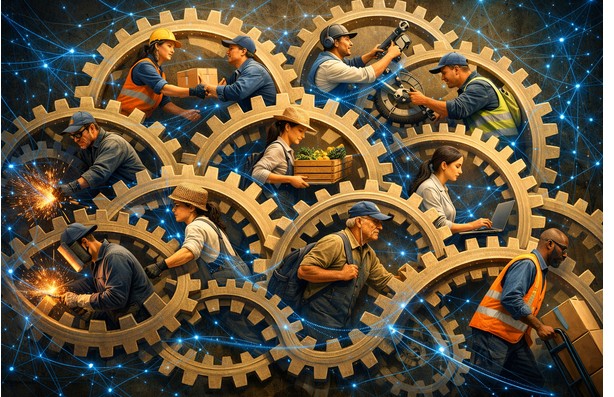
Ultimately, an integral organization is one in which people begin to move together without external coercion. No one pressures anyone, yet all are coordinated. Like perfectly matched gears that turn together without friction, each one feels the other, understands the other, and participates in one common motion. This is already an analog and integral state. In such a state, paradoxically, we reach true freedom. No one compels us, and we compel no one. We move together with others by virtue of mutual understanding, inclusion, and love. That is the real goal of managing change in an integral way.
Based on “New Life 125 – Effecting Change” with Kabbalist Dr. Michael Laitman. Written/edited by students of Kabbalist Dr. Michael Laitman.