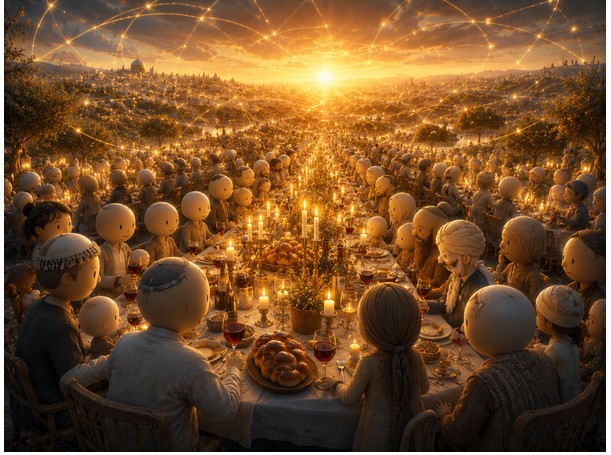
Shabbat symbolizes a corrected humanity, which exists in delight, what is called “the delight of Shabbat” (“Oneg Shabbat”), in a state of rest. It is a state of us human beings having completed the transition from narrow egoism, where each person feels separate and disconnected from others, to a perfect bond of love. In that state, we function as parts of an integral system. The general law of development is guiding humanity to precisely such a connection.
In the sources, this state is described as “a world that is entirely Shabbat and rest” or “the world to come.” This is how it is explained in the wisdom of Kabbalah, which also teaches the method for rising above egoistic nature and attaining eternal love.
Now let us return to the beginning.
In nature, there is day and night. There are astronomical signs that determine months and years through the moon and the sun. But Shabbat? There is nothing in nature that directly corresponds to it. Shabbat does not belong to anything in this world. Instead, it originates with the first human being.
The Torah relates that humanity was created on the sixth day of creation, and afterward Shabbat was established. As we know, tens of thousands of years ago human beings emerged from the animal world. The human being referred to here is the first person who began to think about correcting egoism, i.e., the desire to enjoy at the expense of others, and creating connections like those found in a healthy family.
The discovery that this is the highest purpose of our existence marks the point from which the history of the world is counted, and it is called “the eve of Shabbat.”
The work that leads to the rest symbolized by Shabbat is not the kind of work we know in agriculture, industry, finance, or commerce. It is the spiritual work of building an attitude of love toward all people.
It is written, “On the Sabbath He rested and was refreshed” (Exodus 31:17). This means that we will eventually reach a stage in our spiritual development where no effort will be required to love others, because we will have completed our self-correction and attained perfect love among ourselves.
In that perfected state, everyone cares for everyone else, and therefore no one needs to worry about themselves. All are filled with light and joy.
Until we reach that state, the “day that is entirely Shabbat,” we are given a weekly Shabbat, which is described as “a taste of the world to come,” alongside a series of corrections represented by the six weekdays.
Based on “New Life 171 – The Sabbath” with Kabbalist Dr. Michael Laitman. Written/edited by students of Kabbalist Dr. Michael Laitman.
Posted on Facebook, Instagram, LinkedIn, Medium, Quora, Twitter X, YouTube