|
Getting your Trinity Audio player ready...
|
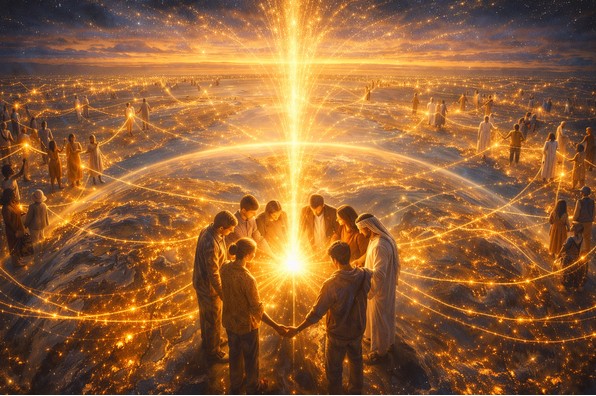
Today we must understand a fundamental fact about the world we live in: humanity has become completely interconnected and interdependent. This did not happen yesterday. The process has been unfolding for at least the past hundred years, and it began to become especially evident around the time of the First World War.
Since then, the connections between people, countries, economies, and societies have only intensified. The world has become one integral system. However, although we are objectively interconnected, we do not recognize it and we do not behave accordingly. Each of us still wants to live separately, to go our own way, and to think solely about our own benefit.
The problem is that we do not have a natural inner ability to perceive this global system. A person cannot instinctively feel the needs of all humanity or calculate the benefit of everyone in each of his actions. Our nature is egoistic. In other words, we desire to enjoy at the expense of others and the world. Therefore, when we discover that the world is interconnected, we simply try to ignore this fact. We behave as if it does not exist because we do not know what to do with it.
However, the problem does not disappear. Evolution continues to push humanity forward whether we like it or not. Human society is developing in the direction of becoming increasingly integral and mutually dependent. Since we resist such an evolutionary trajectory, we experience crises that constantly deepen. For a long time these crises seemed manageable. We saw problems in culture, education, family life, rising divorce rates, suicide, drugs, and a general feeling of helplessness. Yet as long as these problems did not directly threaten our economic stability, society learned to live with them.
When crisis directly affects our livelihood, then we are forced to take notice. Whether it is the collapse of financial systems, the struggle to survive of industries, or millions of people losing their jobs or becoming displaced, when these events touch our own lives, we are hit by myriad stresses and anxieties.
The paradox is that humanity actually produces more than enough for everyone. Each year the world produces far more food than is necessary, yet enormous quantities are thrown away. At the same time millions of people suffer from hunger. The problem is not a lack of resources but the lack of positive human connection. We simply do not feel responsible for one another. A person might know that half the world is starving, but as long as their own refrigerator is full, they do not feel it as their own problem.
When humanity enters such a crisis, another phenomenon inevitably appears: the rise of antisemitism. Historically, whenever societies experience severe economic or social distress, accusations against the Jews intensify. This pattern repeats again and again. When life is stable, the hostility remains relatively hidden. But when crises erupt—especially financial crises—people instinctively search for someone to blame, and very often the blame falls on the Jews.
This is not a coincidence. Antisemitism exists as a deep instinctive phenomenon within human nature. Its roots go back to ancient Babylon, when a group of people gathered around Abraham and discovered a method of positive human connection. They learned how to unite above their egoism and how to connect to the higher force of nature, the force of unity, abundance, and balance. That group eventually became known as the Jewish people.
The world subconsciously feels that the Jews possess something essential for humanity’s well-being—a method of connection—and that they are not providing it. Even if people cannot articulate this clearly, they feel that the Jews hold a key to something that could improve life but are withholding it. This instinctive feeling fuels antisemitism.
For this reason it is extremely important that the Jewish people begin to share the method of connection with the world. The practical form of this method today is what I call “integral education” or an “integral approach to education.” Integral education is not only for children. It is for every human being—adults, youth, professionals, workers, everyone—because the entire world now exists within a single interconnected system.
Integral education teaches people how to live correctly within this global network. It explains how human relationships function inside an integral system and how cooperation, mutual responsibility, and connection can be developed above our natural egoism. This education addresses the root of the myriad crises we can see in our world: the collapse of family structures, failures in education, cultural breakdowns, economic instability, and social alienation.
The wisdom of Kabbalah is the source of this method. Kabbalah itself is essentially the science of human connection. However, it should not be misunderstood as mysticism or something mysterious. The classical Kabbalistic texts, such as The Book of Zohar and the writings of the great Kabbalists, describe the deeper psychology of unity. They explain how the forces that connect human beings operate and how a network of relationships between us reveals higher forces of love, reciprocity, and bestowal.
In Kabbalah we study how human beings can rise above egoistic perception and begin to experience reality through connection with others. Within that connection a new force becomes revealed, the collective force that Kabbalah calls “the soul.”
Of course, not every person needs to study Kabbalistic texts in the early hours of the morning as serious students of the wisdom do. Just as in any science, there are specialists who research and develop the knowledge. Those specialists then translate their discoveries into practical systems that society can use. The same applies here. Kabbalists study the deeper principles, and from these principles we develop practical educational frameworks that can be implemented in society.
In this sense, integral education can be viewed as the applied form of Kabbalah, similar to applied psychology. It translates the fundamental laws of human connection into practical tools that people can use in everyday life.
This is exactly what Abraham did thousands of years ago. He gathered people together, taught them how to unite above their egoistic differences, and within that unity they began to discover new laws of nature. Those discoveries formed the foundation of the wisdom of Kabbalah.
Today humanity must return to that principle. The method of connection that once developed within a small group must now be shared with the entire world. This is the meaning behind the statement that the people of Israel should be “a light unto the nations.” It refers to the responsibility of bringing the method of positive human connection to humanity.
If we begin to disseminate integral education widely, we will see a remarkable change. The hostility toward Jews will begin to decrease because humanity will instinctively feel that it receives what it needs. The same instinctive force that now produces hatred can transform into appreciation and friendship.
This is why the development and dissemination of integral education is so important today. Humanity is entering a new stage of evolution in which we must learn how to live as a single interconnected system. The sooner we begin educating ourselves toward this form of connection, the easier our transition into this new reality will be.
Based on “Living in Interdependent Times – Jtimes with Kabbalist Dr. Michael Laitman.” Written/edited by students of Kabbalist Dr. Michael Laitman.
Posted on Facebook, Instagram, LinkedIn, Medium, Twitter X, YouTube, Quora, The Times of Israel