To understand the secret of Jerusalem, we must journey back to ancient Babylon. There begins the story of the people of Israel, the foundation of the nation.
It was Abraham the Babylonian, a persistent seeker, who discovered that nature is a single system. At that time, a great war was raging, accompanied by a tremendous eruption of egoism, i.e., the desire to enjoy for self-benefit alone at the expense of others. As the Midrash says, “Half the world fell by the sword” (Pirkei de-Rabbi Eliezer, Chapter 24).
Abraham tried to explain that if people rose above their egoism, they could build bonds of connection and mutual complementarity, and in those bonds discover the single force operating throughout creation, the force of life and love.
The few who listened became his students, forming the community known as the House of Abraham, a collection of strangers united by a common idea and method. From them, our people eventually emerged, as Maimonides describes in The Book of Knowledge.
“Love covers all transgressions” is the method of proper Israelite connection. The process is quite complex. It contains stages and degrees of connection that must be learned. Together, these stages are considered the spiritual construction of the Land of Israel.
The word “Eretz” (“land”) symbolizes desire, while Israel signifies a clear direction, from the two words “Yashar-El” (“straight to God”), i.e., straight to the force of love.
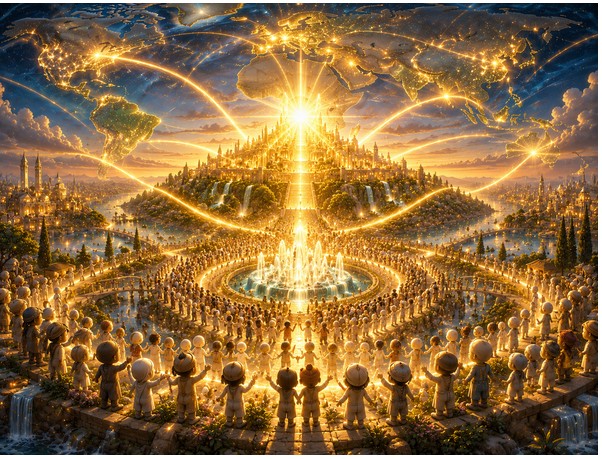
The bonds of love built above hatred are like bridges between people. From each person a bridge extends to another, and all the bridges connect together until, above them, a kind of dome is formed. At the center of this dome emerges the heart of the Land of Israel, which is Jerusalem.
The initial ascent above egoism in order to build a bridge to another person is also called an exodus from egoism. This departure is hinted at in the name “Zion,” the Land of Zion, the City of Zion.
By egoism, we mean everything in human nature that opposes mutual connection, the desire to use others for self-benefit, to exploit them for personal pleasure, and to put them down in order to elevate ourselves.
King David declared: “If I forget you, O Jerusalem, let my right hand forget its skill. Let my tongue cling to the roof of my mouth if I do not remember you, if I do not set Jerusalem above my highest joy” (Psalm 137). To place Jerusalem above our highest joy means to develop to a state where our greatest happiness comes from our connection to each other in love.
From the perspective of our egoistic nature, this may be difficult to imagine. Yet this is the truth. There is no better and more complete state than one in which everyone feels one another and lives in mutual responsibility.
Such connection lifts us above narrow calculations, above fear of being harmed by others, and above life’s pressures and problems. Through bonds of love, our perception of reality expands, and a higher world becomes revealed, a “good and spacious land” radiating goodness, delight, tranquility, and peace.
During the three pilgrimage festivals, the people would ascend to Jerusalem. What many do not realize is that the primary purpose of these pilgrimages was to gather together and bring hearts closer, building the unity through which the one force could be felt. With every step toward Jerusalem, a person was expected to open their heart a little more, preparing themselves for love of others.
The sources describe the unique atmosphere that prevailed there. Pilgrims were welcomed with open arms. The residents of Jerusalem hosted them in their homes and treated them like family. “All the craftsmen of Jerusalem would stand before them and greet them, saying: ‘Our brothers from such-and-such a place, have you come in peace?’ And the flute would play before them until they reached the Temple Mount” (Mishnah, Bikkurim 3).
No one who came to Jerusalem lacked anything. “No person ever said to another: ‘I could not find an oven in Jerusalem to roast my Passover offering,’ or ‘I could not find a bed in Jerusalem to sleep on'” (Avot de-Rabbi Natan, Chapter 35).
The upper force dwelled in these bonds of love. Everyone felt free and joyful, liberated from personal worries, and able to devote themselves to the good of the whole. The sages even tell of non-Jews who witnessed the inspiring spectacle of the pilgrimages and wished to join that sea of love: “They ascended to Jerusalem and saw Israel… and said, ‘There is no nation more worthy of attachment than this one'” (Sifrei Devarim 354).
This was Jerusalem in its original essence. But later it was destroyed. Egoism grew stronger and led to a terrible civil war. Since then, unfounded hatred has dominated the nation, and every day that we fail to cover it with love, the destruction continues.
According to our inner structure, the people of Israel were destined to undergo four exiles and four redemptions before becoming capable of leading humanity to connection and harmony. Today, we stand at the threshold of the final redemption. To merit it, we must perform the same work of building bridges from person to person and renewing bonds of love above the hatred that emerges.
It is no coincidence that the world today is experiencing a comprehensive crisis. With egoism constantly growing and interdependence steadily increasing, reality has become extremely unstable. Humanity will not be able to continue living safely on Earth unless the nature of human relationships changes.
The future of the world depends on our ability to build the rebuilt Jerusalem. There is little value in constructing a Temple of wood and stone, it would be no more than a museum. We need to learn how to elevate our hearts to the spiritual level called the Holy Temple. A house of holiness is a heart filled with love. When we begin advancing together toward connection and mutual complementarity, the power hidden within the spiritual concept of Jerusalem will be revealed.
The city of conflict will become a center of education and guidance, from which the method of connection will spread to humanity. Then everyone will understand their deep attraction to Jerusalem, which will be revealed as a fountain of life, the capital of peace and love for all nations.
From the Sources:
“The Israeli nation had been constructed as a sort of passageway by which sparks of refinement would flow onto the entire human race throughout the world. And these sparks of refinement multiply daily, like one who gives to the treasurer until they are filled sufficiently, meaning until they develop to such an extent that they can understand the pleasantness and tranquility that are found in the kernel of love of others.”
—Kabbalist Yehuda Ashlag (Baal HaSulam), “The Arvut (Mutual Guarantee)“
“‘Jerusalem, built as a city joined together’ means that Jerusalem is built through the unity of the people of Israel and their awakening in love and awe.”
—Rabbi Yisrael Hopstein of Kozhnitz, Avodat Yisrael, Parashat Devarim.
“The desire within a person’s heart is called ‘land’… The Land of Israel means having a desire that is Yashar-El (straight to God)—that is, not desires of self-love, but desires of love for others. … A person’s heart should be a Holy Temple. … Therefore, a person must strive to build their structure of holiness.”
—Kabbalist Baruch Shalom Ashlag (RABASH), The Writings of RABASH.
“In the future, Jerusalem will gather within it all nations and all kingdoms.”
—Avot de-Rabbi Natan, Chapter 35.
Based on “New Life 173 – Jerusalem And The Power Of Love” with Kabbalist Dr. Michael Laitman. Written/edited by students of Kabbalist Dr. Michael Laitman.
Posted on Facebook, Instagram, LinkedIn, Medium, Quora, The Times of Israel, Twitter X, YouTube