|
Getting your Trinity Audio player ready...
|
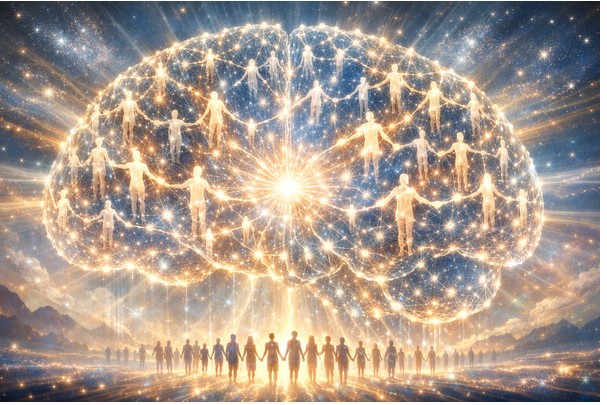
The world is changing, and individual thinking is no longer sufficient for analyzing problems and finding solutions. The future of organizations depends on developing shared emotion and intelligence. This is what the integral approach to education teaches. Below are several principles, tools, and exercises.
First, it is important to remember that the entire universe developed from one small spark. Since then, the evolutionary program has developed parts of matter in many directions, yet all belong to one system. Therefore, when people learn to connect with one another, they develop a greater ability to understand that single force that governs us, the general force of nature.
Through special connection exercises, people build new shared feelings and a common understanding. Step by step they begin to discover what governs and motivates them, where their desires and thoughts come from, and how they can combine them to create a new common desire and a new common mind, one that belongs not to any single individual but to everyone together. Through this process they can begin to sense the surrounding nature, the larger system, discover what it wants and what direction it guides their development to. This becomes a tool for seeing the future, understanding what is likely to happen, and preparing themselves in advance.
Why is this necessary? The reason is that life teaches us that in a world becoming increasingly global and integral, more connected than ever, individual tools of thinking are no longer sufficient. It is because we lack common thinking tools, even in situations where it is clear to everyone that people must unite in order to confront threats or advance progress, they still fail to do so. This happens at levels of organizations, businesses, human societies, and also in international relations.
This is where the integral approach to education enters and provides a method for developing integral relationships and connections between people. Its implementation can take place in the workplace, in the family, and throughout society. The method combines in-depth study of human nature and the overall direction of development with connection exercises and connection workshops.
Connection Exercises
There are many games and exercises designed to develop connection between people: exercises involving speech, eye contact, listening, movement, and more. Participants might close their eyes and begin speaking with their eyes closed, cover their ears while looking at one another, or communicate messages through eye contact alone.
In other exercises, participants sitting in a circle pass messages to each other and make sure the message remains accurate as it moves around the circle. Pantomime exercises are also very important, the expression of oneself through movements without words. The goal is to help a person come out of isolation within themselves and begin connecting with others.
Once some connection has been formed, role-playing exercises can help participants adopt and shed different roles in order to develop and express positive attitudes to others. People need considerable practice before they can see themselves from the side and observe their own egoistic nature from a higher perspective.
Such role-playing exercises help people learn how to rise above the ego and develop self-control. Through them we conduct a kind of research on ourselves, examining how—despite a strong ego—we can act in the opposite direction to construct connection and warm attitudes to others, even reaching the level of love for others.
This is how we develop what is called “three lines.” The left line represents the natural egoistic attitude toward others. The right line represents the positive attitude a person aspires to develop through the exercises. Between these two lines a middle line emerges, where the person consciously and freely manages their own development.
The Connection Workshop
A connection workshop is conducted in small groups of up to ten participants. The facilitator raises a question for discussion or gives participants a task, and each person speaks in turn. The workshop has special rules that help participants make space within themselves for the opinions of others, include one another’s perspectives, and learn to appreciate one another.
For example, participants may be asked to look at the others and begin speaking in their praise, describing how important, intelligent, and unique they are. It is clear that such praise may not necessarily reflect what we truly think. Yet, much like small children who play at “being someone else,” we do the same. We play in order to grow and develop.
For example, we look at our colleagues sitting beside us in the circle and praise them: “I want to tell you that you are so intelligent, sensitive, understanding, energetic, and successful in everything you do.” Each participant is uplifted and praised in this way, and in turn others do the same for us.
This exercise helps each person rise above their personal viewpoint and realize that there may be entirely different ways of seeing others beyond our usual perspective. At the same time, the exercise brings people closer together and helps build a shared emotional capacity.
During the exercise we give up all criticism of one another, regardless of who the person may be. Perhaps these are people who are not especially successful at work, who often make mistakes or even cause serious problems. It does not matter. At that moment we set everything aside and focus solely on the person’s positive qualities.
It is important to understand that connections like these build a new level of a shared existence. We cannot progress or develop if we continue to view everyone negatively through the narrow lens of ego, lowering others only in order to raise our own value. At the new level, a person’s value will be measured by how much they are able to elevate the value of others in their eyes, despite what the ego initially tells them.
Much more could be said about the integral approach to education, its principles, and its tools, but this is not the place for a full discussion.
Throughout history human development has progressed through changes in the form of relationships between people: the era of slavery, feudalism, capitalism, the modern era, the post-modern era, and now we stand before the next fundamental change. Integral connection between everyone and everyone else, above our narrow egoistic nature. In this way we will climb to a new evolutionary level in human and social existence and discover together that the future world can only be a connected one.
Based on “New Life 118 – The Collective Mind” with Kabbalist Dr. Michael Laitman. Written/edited by students of Kabbalist Dr. Michael Laitman.