|
Getting your Trinity Audio player ready...
|
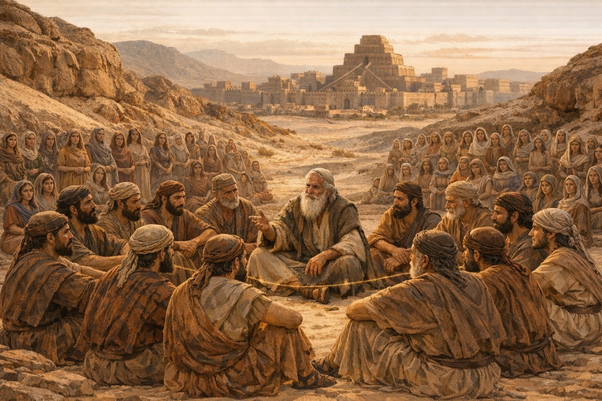
Abraham changed the course of world history. He was the first person to call on the Babylonians to confront the growing egoism that had suddenly erupted in Ancient Babylon. Until that time, Babylonian society had developed peacefully. Located between the Tigris and Euphrates rivers, it was the center of the entire civilization of that era. About three million people lived there. By today’s standards this was not a large population, but in the ancient world it was practically the whole of humanity.
Life in Babylon was simple and abundant. People farmed grains such as wheat, rye, and buckwheat, grew onions and garlic, raised sheep, and caught plenty of fish. Historical evidence even remains in ancient inscriptions and frescoes describing everyday exchanges between people, reflecting a quiet and cooperative society. People lived like neighbors, friends, almost like members of one family.
But suddenly something changed. Egoism began to grow among them. Competition and calculation entered their relationships. Instead of simple cooperation, people began measuring everything in terms of personal benefit, how much one gives and how much one receives in return. Relationships that had once been warm and natural turned into egoistic calculations. This shift led Babylon into a deep and painful crisis.
The famous story of the Tower of Babel symbolizes this crisis. Humanity’s growing egoism pushed people to attempt to rise above nature itself, to conquer the heavens and place themselves above the forces governing reality. They imagined that by their own power they could dominate nature and even that of the single upper force of love and bestowal that governs reality, the Creator.
It was precisely at this moment that Abraham appeared. He saw that the root of the crisis was the rapidly expanding human egoism. Instead of trying to suppress it or escape from it, he proposed a completely new solution: people must rise above egoism through connection and mutual responsibility. Abraham called on the Babylonians to unite, not by returning to their former naive state, but by consciously building relationships of love and connection above their growing egoism.
This was a revolutionary idea. Many revolutions in history were carried out through force or power, but Abraham introduced a completely different kind of revolution, the inner revolution of human relationships. He gave humanity the key to influence reality itself: by correcting human relationships, one could influence not only this world but the deeper and higher forces governing it.
Of course, Abraham was not the first Kabbalist. According to the Kabbalistic tradition, he lived in the twentieth generation after Adam, the first person who discovered the spiritual world. But Abraham was the first to bring this method to society as a whole. In a time of crisis, he revealed a practical method for humanity’s correction.
Before Abraham there was also Noah, who lived ten generations earlier. Noah carried out a different kind of mission. In the story of the flood, he saved humanity from destruction by entering the ark with those close to him. The ark symbolizes the quality of Bina, the giving force that rises above egoism. Noah preserved a group of people above the “flood” of egoism that threatened to destroy humanity.
However, Noah’s solution was limited to preserving a small group, almost like a large family living together. Abraham’s mission was different. By his time, egoism had already spread throughout all of society. Humanity consisted of many tribes and clans, each increasingly divided by egoistic interests.
Abraham revealed that salvation lay not in isolating a small family group but in uniting people above their differences. He convinced many Babylonians that their only way forward was to come together despite the egoism separating them. Since the crisis was so fresh and people still remembered the peaceful life they had lived before, many were ready to listen to him.
Those who followed Abraham formed a group based on a new principle: connection above egoism, unity above division. Within this group they began learning how to build correct relationships with each other. In these new relationships they discovered the deeper laws of reality and the force that governs it.
This group later became known as “the people of Israel,” with “Israel” coming from two words, “Yashar-El,” i.e., those who had the desire to go “straight to the Creator.” Through them Abraham’s method, the wisdom of Kabbalah, was preserved and passed down through the generations as a method for correcting human relationships and guiding humanity through future crises.
Based on a Virtual Kabbalah Lesson on May 29, 2016. Written/edited by students of Kabbalist Dr. Michael Laitman.
Posted on Facebook, Instagram, LinkedIn, The Times of Israel, Twitter X, YouTube, Quora