|
Getting your Trinity Audio player ready...
|
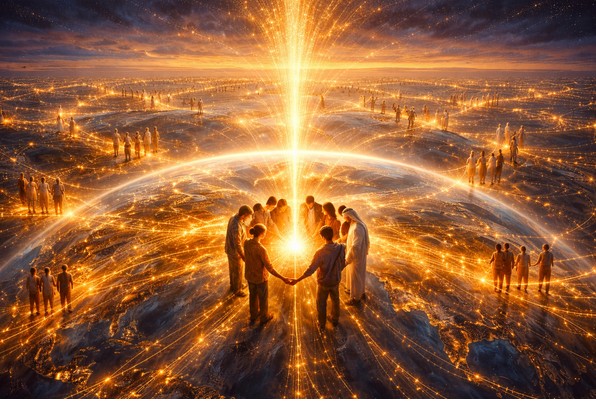
To understand how the principles of the wisdom of Kabbalah can be applied to build an integral human society today, we should first understand the concept of the soul as Kabbalah describes it. We need to defocus our current understandings of the soul as it is commonly understood in the world. People usually imagine the soul as something personal that exists inside each individual. But according to Kabbalah, a soul is not something private that belongs to a single person. A soul is a collective phenomenon. It is the common desire that exists between people when they become harmoniously connected together.
The Torah speaks about a single human being at the beginning called “Adam HaRishon,” which is Hebrew for “The First Man.” This does not refer to a biological person but to a single collective system of desire. Later this system was divided into many parts, which appear to us today as separate human beings. In reality, however, we are all fragments of that single original soul.
Therefore, a soul is not something that exists inside an individual. A soul is created between people when they connect correctly, in a common attitude of love and bestowal. When people unite from heart to heart, when they build relationships based on mutual love, reciprocity, and the principle “love your neighbor as yourself,” a special force appears between them. That collective force, created by their connection, is what Kabbalah calls “the soul.”
No person possesses a soul on their own. A soul exists only in relation to others. When a person wishes to connect with others in equality, reciprocity, and bestowal, when they rise above their ego and apply themselves to be included in others, this connection forms the vessel called “the soul.” It does not matter whether other people know about it or not. A Kabbalist could sit quietly in a room without anyone knowing about him, but if he develops within himself a genuine desire to connect to the hearts of others and to help them become connected with one another, then he begins to participate in that collective desire. This participation is called “acquiring a soul.”
In Kabbalah this collective connection is sometimes called the “assembly of Israel,” meaning the gathering of all souls that aim themselves at connection. Ultimately, this collective soul must include not only those called “Israel” but also all the souls of the nations of the world. In the end there is only one soul for all humanity.
If we have no desire to connect with others, if we do not wish to unite with others “as one man with one heart,” then we have no soul. The soul does not belong to an isolated individual. It is the common field that appears between people when they unite correctly. Just as cells in the body function together in harmony, each performing its own role while serving the entire organism, so human beings must connect in a single system. The collective force that emerges from their harmonious cooperation is the soul.
Within that connection a person begins to feel the upper force, which Kabbalah calls “the Creator.” The Creator is revealed precisely in the relationship of love and bestowal between people. That is why the sages stated that the soul is “a part of God from above.” The degree to which we build loving connection with others determines the degree to which we feel the Creator.
This state is called “adhesion with the Creator.” It is a state that we can achieve through connection with others. The stronger and deeper the connection we acquire with other people, the greater the degree of adhesion we attain. When humanity eventually reaches complete connection with everyone, that state is called “the end of correction” (Gmar Tikkun). Then, the complete collective soul becomes revealed, the one soul that belongs to all.
We each attain this collective soul from our own unique point. Therefore individuality is not lost. Just as every cell in an organism contributes its unique function while participating in the life of the whole organism, each person retains their individuality while participating in the common soul. From one’s own perspective, one attains the whole system. This is why the sages said that through love of the created beings one comes to love of the Creator. Love for others is the vessel in which love for the Creator appears.
There are also different roles in this collective soul. Some desires within humanity have a special inclination toward connection. These desires are called “Israel.” The word Israel comes from “Yashar-El,” meaning “straight to the Creator.” It describes those who feel a strong inner urge toward unity and toward the revelation of the force of connection.
This does not necessarily mean it is easier for them to connect. In fact, it can be more difficult. They feel the urgency and importance of connection, but they also possess strong egoistic forces that resist it. This tension gives them free choice.
The souls of the nations of the world represent desires that do not naturally feel this same unifying urgency. They are more individualistic. Historically, however, the people of Israel developed a culture that emphasized learning, mutual aid, communal life, and responsibility for one another. This tendency toward collective life remained even during long periods of exile.
Today, however, humanity is experiencing an unprecedented rise of egoism. Over the past century the ego has developed to such a degree that even the natural bonds that once existed among the people of Israel have weakened. We see alienation, corruption, and division within Jewish communities. This is not accidental. Humanity was meant to begin correcting its ego long ago, aligning itself with the increasingly global and interconnected world. But we did not do so. As a result the 20th century brought terrible events, including the Holocaust, and the same crisis continues today.
Humanity now faces a global system in which everyone is interconnected whether they like it or not. Nature itself is forcing us into a global structure. The role of Israel within this system is to begin building the correct positive human connection and to show the method of unity to the rest of humanity. This is what it means to be “a light unto the nations.”
The world subconsciously expects this example. Much of the hostility directed toward Jews throughout history stems from the fact that this role has not yet been fulfilled. If the people of Israel begin to demonstrate true unity and mutual responsibility, it will create a completely different relationship between them and the nations of the world.
Exile in the spiritual sense does not mean living outside the physical land of Israel. Exile means being outside of connection. A person could live anywhere in the world and still participate in the gathering of Israel if they strive for unity with others. The physical location is secondary. What matters is the desire for connection.
Historically, the Jewish people were scattered throughout the world precisely in order to carry the potential for connection into every society. When they begin to implement this connection among themselves, it will naturally influence the surrounding nations. The concept of the “Land of Israel” ultimately represents a desire directed toward the Creator, a desire for unity. In the future this quality must spread throughout the world.
Humanity is now approaching a critical stage. The intensifying problems we see today reveal that the world cannot continue to exist based on egoistic separation. If we do not learn how to connect correctly, the systems of human civilization will collapse under the pressure of this integral reality.
But if we begin to build true connection among us and teach the method of unity to the world, we will open the path toward a completely new and harmonious stage of human development. This is the true correction of the world, Tikkun Olam.
Based on “The Collective Soul & The Jewish Soul – Jtimes with Kabbalist Dr. Michael Laitman.” Written/edited by students of Kabbalist Dr. Michael Laitman.
Posted on Facebook, LinkedIn, Medium, Quora, Twitter X, YouTube, The Times of Israel