|
Getting your Trinity Audio player ready...
|
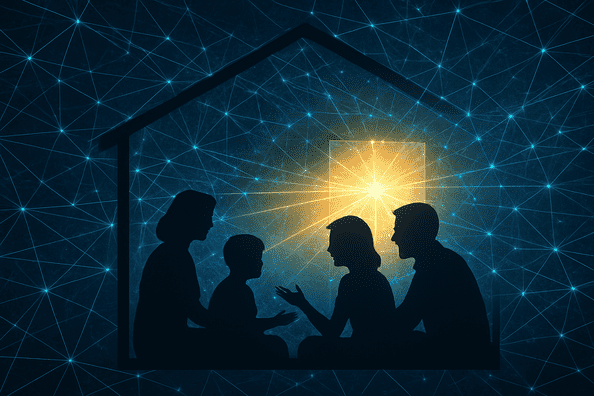
A home was once an open space. Today, it is divided into separate rooms. Each family member is secluded in their corner, meeting in the living room mainly when something is needed from the parents. Then, in times of financial pressures, when it is impossible to provide everything everyone demands, anger, stress, and conflicts arise.
In previous generations, it was clear that a person without a family would struggle to survive. Later, we developed social services to cover life’s essentials, but it is clear there is no substitute for the warmth and loyalty we can feel in the embrace of a loving family. Even financially, we can understand that it is cheaper to live together, and yet many families break apart. Incidentally, it is profitable for the elites who pull the strings behind what society appreciates, since by living alone, we must purchase full sets of products for ourselves, and so in recent decades divorce and living alone have been made to look good.
Be that as it may, families that still exist and wish to improve their state need to know that everything depends on the level of connection they learn to create at home. If there is a good bond, if there will be consideration and mutual complementarity, not even financial distress will bring them down. Moreover, the deeper their connection grows, the more they will see troubles disappear the moment that they appear. Abundance begins to reach them. Then, they realize that life is like one big game, the purpose of which is to connect us lovingly to each other.
On the way to this higher realization, we have educational work to do, both on the general-social level and on the family level. Also, environmental influences such as communication, media, and culture influence the family, and they can be optimized to help expand people’s perception and create a new spirit.
For instance, one idea could be a mini-series that brings us inside the life of a typical family. In every episode, we see family members come out of their rooms to the living room, arguing about various money-related issues, expenses, budget, and priorities. Sometimes neighbors or friends also enter, with similar problems. Maybe in the middle of the argument, on the TV in front of them, the news reports more price hikes and other economic problems. The series could also show families from around the world connecting to each other, sharing the economic difficulties they endure, looking for solutions.
The goal of such media is to extract the person from their home, so that they can see the economic struggle as a global-social phenomenon. In one’s country of residence and around the world, families struggle to support themselves. This leads to myriad family arguments, but it also requires a more mature look at the matter. Reality reveals itself in such a way toward us today, and we need to deal with it. If our connection will be closer and warmer, surely we will find creative ways to help and support everyone.
Such examples in a mini-series will awaken the thought that perhaps also in our home it is possible to build a similar spirit of cooperation. We will sit around a round table, connect, and start to think about how we can solve the problem. How much budget do we have as a family? What are the needs of each family member? What can we give up? What alternatives can we suggest? Also, where can we save money?
In the end, it all depends on our perception. There are families that have less, but are happy, and there are those laden with money who are depressed and bitter. The feeling of inner fulfillment is unrelated to assets or wealth. If there is a bond of love that fills the heart with warmth, it is better than a lonely life in a palace. In general, the feeling of fulfillment is something abstract, independent of material things, but on the level of flow created between hearts.
To learn something from its opposite, let us look at the process of enjoyment from shopping. A feeling arises in us that if we buy something, it will make us feel good. So we go, buy, enjoy for a few moments, and then we are done with it. The pleasure disappears. Again, we need something new to run after. The same process happens in sex, and in every other satisfaction: every fulfillment we achieve doubles the feeling of emptiness. As long as we receive the fulfillment inwardly into ourselves, the enjoyment of it fades. It is transient.
Love in the full sense of the word means to take the desire of the other as if it were our own, to try and fulfill it as if you were fulfilling yourself, to use all of your powers for them. This is the direction of the great rule “Love your neighbor as yourself,” and at the height of the human spirit’s development. It will become the code of life in society. Its practice can begin in the family circle, and from there, a warm circle of connection can expand outward, to the building, the neighborhood, the city, the state, and to humanity as a whole.
When we see what is happening in the interconnected world, how mutual dependence rises, how economic difficulties and the cost of living intensify, how global threats prove that we are all in the same boat, then we understand that it is better to prevent than to cure. Doing so requires igniting a revolution in perception: an educational, cultural, and social revolution that will move us all as one to the next degree of evolution.
Tomorrow’s world can only be a connected one, which means to live like a healthily-functioning family, i.e., with positive connection, warmth, and support. The surrounding nature functions harmoniously and peacefully in such a way, and it developed the wonderful fabric of life. Today, humanity is also required to join this flow: to function like organs in one body, but out of scrutiny, awareness, and choice. This is the ladder we will climb to the highest height, and realize our potential as the crown of creation.
Based on “New Life 75 – Money in the Family” with Kabbalist Dr. Michael Laitman. Written/edited by students of Kabbalist Dr. Michael Laitman.
Posted on Facebook, Instagram, LinkedIn Newsletter, Medium, Twitter X, YouTube