|
Getting your Trinity Audio player ready...
|
In today’s reality, where everyone influences everyone else, most of our problems stem from poor relationships. Ego games throughout society, whether in business, at work, and even in relationships and families, sour our lives. On one hand, life forces us to connect to one another, but on the other hand, we each have a very large ego that causes us to prioritize our own interests over everyone else’s. To advance from here to a better future, we need a new way of life.
The most natural place to develop a new approach to ourselves and to others is in the couple’s relationship, the place where a lack of connection hurts us the most. It is not by chance that today’s relationships are becoming very difficult and the family unit is falling apart. This is nature’s way of hinting to us that it is time to upgrade our ability to connect with one another. If we learn to develop feelings, an understanding, attitude, and the optimal approach toward our partner, we will acquire new tools, senses, and discernments that will let us understand everyone around us, live in harmony with the world, and succeed in every area of life.
Our partner was given to us as help to develop the best possible connections we can. In our relationship, we can identify and clarify all subtle discernments, pleasant or less so, which are embedded in our character and worldview. With their help, we can learn how to use our traits to develop an optimal connection with one another throughout society.
From the outset, we are both egoists and thus very distant from each other. To develop our ability to step out of our narrow self-centered perspective and begin to feel reality through the other, we need to mutually clarify what each of our desires and aspirations are, and what we would like to see in ourselves and in our partners. Then, we will each try to listen with our whole heart to the other, to absorb them inward into ourselves. Gradually, we will each form a picture of the other, an inner map of them. Later, we will try to leave our own starting point and begin to draw closer to them until we can touch each other internally. This will create a common space between us, and we will strive to expand it more and more. This closeness, connection, and growth are all based on the principle of concession.
Concession is a heavy word. Who likes to concede? Usually, concession is seen as something for the weak. “They pressured me,” people say, “so I had to concede.” But here we are talking about a completely different kind of concession. We give up our natural tendency to feel and to consider only ourselves, which locks us inside our narrow world. The concession comes from our desire to develop ourselves as human beings, to expand, to feel more of life, and the world outside us. We wish to acquire the desires, thoughts, passions, and fulfillments of others. Doing so will give us new tools and new possibilities to enjoy life. In some way, it is like a mother who has given birth to a baby. Her natural love for her baby makes her enjoy giving to her baby even more than the baby does. Can we say she is conceding, that she is losing something? The opposite is true. She would not trade that pleasure for any wealth in the world.
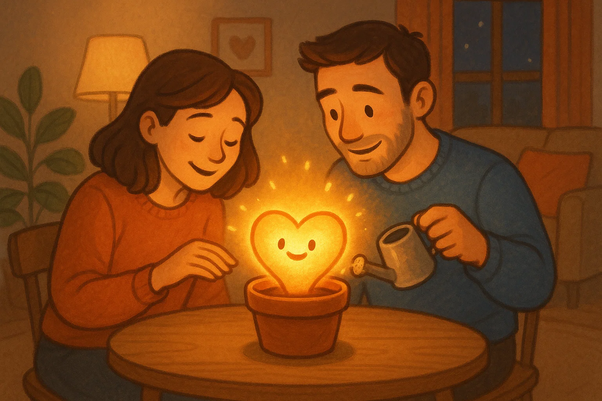
Love is a pet that we raise as a result of mutual concessions. That is what my teacher, Kabbalist Baruch Shalom HaLevi Ashlag (RABASH), had often said. In this developmental process, we need to help each other, give each other positive examples, and discuss how important such development is to us. We need to show each other how ready we are to concede to one another, how much it matters to us that we each feel good and happy, and how much we are willing to invest for one another.
If we concede to each other in every slightest detail and in every small gift we give each other, then we can achieve a tremendous power of connection. It depends on how much we emphasize the inner intention behind each of our actions to each other, the great goal that we want to achieve through concession. We can consider it a couple’s game of sorts, a conscious theater where we act out the next state that we want to reach. We play the roles of the people we want to become, more developed characters each time, who live with greater connection and love for others. Gradually, today’s game becomes tomorrow’s reality.
This kind of concession is called “spiritual concession,” and it is not at all negative. We give up our ego in order to acquire something much greater, higher, and better. Spiritual concession does not enslave us to others. Instead, it lets us exit ourselves. We build the common space between us when we each rise above ourselves. We need to treat the desires and thoughts of our partners as more important than our own desires and thoughts, placing ourselves in their service. Then, we dress into them, and as a result, we begin to see the world through their feeling and mind.
Naturally, we only perceive what can do us good or harm, which enters our closed perceptual box through our five inward-facing senses. Spiritual concession develops in us the ability to rise above our ego’s limits, to begin connecting to the emotions and thoughts of the other. Mutual exercises in conceding to our partners serve as a “spiritual workout” of sorts, which construct our ability to feel others and, later, the entire world in a way that is independent from our ego, i.e., without the involvement of self-interest. This is called an “out-of-body” perception, where we perceive the world as it is before our ego filters it. Over time, five additional new external senses develop in us through which we begin to feel a higher reality.
When this happens, we thank our partners in the developmental process for giving us the opportunity to exit ourselves. We discover that they essentially pulled us out of the selfish prison of ourselves. All the seemingly negative qualities we saw in our partner now appear in a new light. We see how we complement one another. All the protrusions in one fit precisely the indentations in the other, so to speak, like in a puzzle, and through our connection a picture of one person is formed. Feelings such as fears and anxieties, like the fear of being hurt, disappear when we acquire this new approach to life.
Then we also understand why “Love your neighbor as yourself” is the great rule of reality. Through love, we discover an entirely different world to our eyes, an eternal and perfect world. “I saw an opposite world,” said the great ones who merited it, and paved the path of development to it for us all. Accordingly, wise work with our partners can lift us from a world of fights, friction, and endless power struggles to the peak of our evolution as created beings.
“When one comes to love others, he passes from his narrow world, filled with pain and impediments, to an eternal and broad world of bestowal.” – Kabbalist Yehuda Ashlag (Baal HaSulam).
Based on episode 40 of “New Life” with Kabbalist Dr. Michael Laitman. Written/edited by students of Kabbalist Dr. Michael Laitman.
Posted on Facebook, Instagram, LinkedIn Newsletter, Medium, Twitter X, YouTube, Quora