|
Getting your Trinity Audio player ready...
|
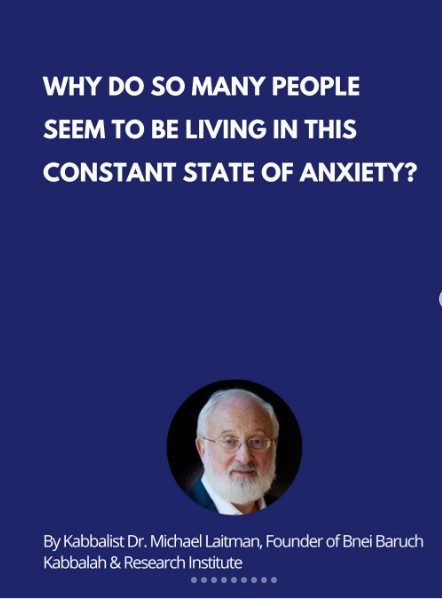
We are made of a desire to receive pleasure and delight, a desire to enjoy, which exists in various degrees. This desire develops qualitatively, becomes more sophisticated, and urges us to bring it new fulfillments. If we once wanted only food, sex, and a roof over our heads, later came desires for wealth, social life, respect, control, science, and knowledge. Within each of these desires, unique flavors, multiple distinctions, and a refines sense of taste developed.
As the desire to receive develops, it manifests in two key ways: pleasure and suffering. Either it feels a certain lack of pleasure, which could continue up to a point of terrible phenomena that cause major suffering, or it feels relative fulfillments up to full satisfaction. We live between this sense of unfulfillment and satisfaction.
The desire to enjoy is our base substance or matter. That is, we host within us a constant sense of lack or need that wishes to pull pleasures inwardly into itself at every given moment. This desire is influenced by innate traits, the upbringing we receive, the environment’s impact, and the values we receive from our families, society, the media we consume, mood, and many other changing factors.
Every one of our movements, consciously or subconsciously, is meant to bring fulfillment to our desire to receive. Day and night, we are busy calculating how to receive maximum enjoyment for minimum effort. Such is the law of optimal fulfillment. Therefore, anxiety over the fulfillment we seek is a constant inner state. Interestingly enough, we are often unaware of the extent of anxiety we host within us all the time because we have simply become used to it.
In addition, we have mechanisms that help us not to desire phenomena that are too great for us, so that we will not become disappointed and suffer. We constantly check what is within our reach and worth aiming ourselves at, and what is too much for us and not worth the worry. Such mechanisms essentially define our anxiety’s boundaries.
Thus, anxieties and worries form a constant background to our lives, and not only us humans, but of every creature in nature. Everyone and everything is made of a desire for self-fulfillment and operates to provide for itself. The important question that arises out of this situation is how can we bring ourselves to a balanced state, where our worries and anxieties are at a level that leads to an optimal self-realization? The point of balance is also the point of health. Therefore, we need to clarify what balance depends on.
We humans are social beings, and the environment greatly influences us. If we could arrange the environment so that it would not spread fear into our lives, we could calm our anxieties and worries.
In order to illustrate this concept, we should imagine a reality in which the media that we consume does not deliberately bombard us with threatening content in order to grab attention and ratings. How would we then experience life? Today’s media channels that we popularly interact with are a major source of stress, imbalance, illness, and pain, both mental and physical.
We should also take into account that from one generation to the next, the social atmosphere is becoming increasingly egoistic. Competition today begins as early as kindergarten, and it quickly becomes destructive and aggressive. Children and teenagers often carry deep, lasting negative impressions from these experiences. Even if they do not express them outwardly, young people accumulate significant anxieties and fears.
The integral approach to education offers a direct response to anxiety, alongside a healing process for society as a whole. The direct response is based on work in a small group of about ten people. Under the guidance of integral experts, a group is built that serves as a protective wall against life’s negative influences. This method teaches how to develop profound mutual human connection, bound by threads of warmth, support, and encouragement.
Incidentally, humor also helps relieve tension. Where there is a clever spark that surprisingly connects two opposites, it makes us laugh and frees us. This is because it touches exactly the frequency that stresses us in life, when we ourselves cannot untangle our own knots. That is why good humor can heal and bring color back to our faces.
As for healing on a global scale, we see that humanity’s evolution has included countless efforts to direct the ego’s development toward a good and beneficial path for society, but instead we have steered it toward harm. This places us into a dangerous place, because the world is becoming increasingly interconnected, while narrow egoism also intensifies. This is the root of all our problems, in our relationships on the international stage, through division that runs rampant throughout society, all the way down to the breakdown of the family unit.
Therefore, we have only one hope: to set out on a universal educational and cultural revolution. Together we must clear the air of negative egoistic influence and begin to elevate integral values of connection, mutuality, support, and consideration. Just as nature connects its myriad parts to form the web of life, so too we must develop the ability to connect as different organs that complement one another.
The future world can only be a connected one. Aligning with it means connecting our hearts together. Will we continue competing in such a world? Sure, but it will be positively-directed competition, for instance, a competition of who contributes more to society, and who uplifts the mood of others more. The more this positive spirit fills our lives, the more we will invite a new vitalizing force that will lift us to the discovery of a whole new harmonious and peaceful world.
Based on “New Life 86 – Fear and Anxiety, Part 1” with Kabbalist Dr. Michael Laitman, Written/edited by students of Kabbalist Dr. Michael Laitman.
Posted on Facebook, Instagram, LinkedIn, Medium, Quora, Twitter X, YouTube