|
Getting your Trinity Audio player ready...
|
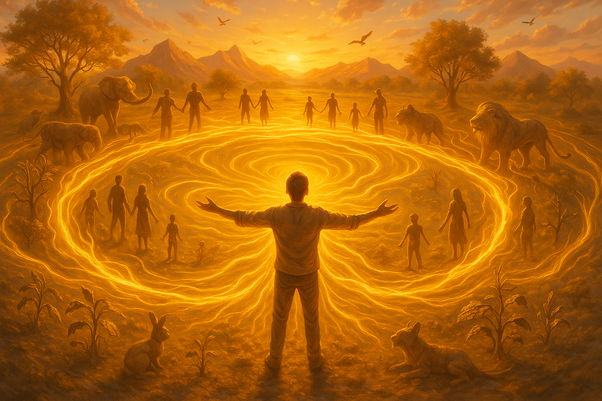
Nature is the Creator, and the Creator is nature. They are one and the same.
In Gematria, Elokim (God) and HaTeva (Nature) share the same numerical value (86) because they refer to the same upper governing force. If we enter into an equivalent relationship with this force, with the Creator or nature, then that force will relate to us in the same way.
About the equal relationship of the Creator and nature, Kabbalist Yehuda Ashlag (Baal HaSulam) wrote in his article “The Peace”:
“HaTeva [the nature] has the same numerical value [in Hebrew] as Elokim [God]—eighty-six. Then, I will be able to call the laws of God ‘nature’s Mitzvot [commandments], or vice-versa (the Mitzvot of Elokim by the name ‘nature’s laws’), for they are one and the same.”
However, these commandments or laws of God are not physics or mathematics. They are the laws of how a human being must relate to everything outside of themselves: to other people, and to the still, vegetative, and animate levels of nature. A heartfelt attitude of love to everyone and everything outside of us is what it means to relate to the Creator. Therefore, nature’s laws, or the Creator’s commandments, come down to one simple requirement: to love others as we love ourselves.
We are born with a quality of self-love. It is our egoism. In other words, our base matter is a desire to enjoy ourselves alone, and to use anything and anyone outside of us for the purposes of self-enjoyment and gain. On the contrary, the love for others is nonexistent in us. It is not even partially existent in an insufficient amount, but it simply does not exist in us. This is why the main commandment of the Creator, or in other words, the general law of nature, is to “love your neighbor as yourself.”
“Neighbor” means everyone and everything outside of us. Humanity, nature, and the entire world. We need to develop within ourselves a sensation of love that flows from our heart outward. It is not a rational calculation of dedicating ourselves a little to charitable and philanthropic causes, but a genuine heartfelt feeling. Likewise, it is actually the hardest thing we can do, because none of us understands what it means to love with the heart.
It is a long process, and not a switch we flip. To love means to relate to others exactly as we relate to ourselves. We do not know how to do this, so we sometimes say half-jokingly: show people a movie about how they love themselves, so they can see how they should love others. Their constant desire to be right, comfortable, warm, and understood is what they must give to others.
If we could step out of ourselves, annul our absolute need to always be right, and say to another, “You’re right,” we would already be moving toward love. This is serious inner work. But if we manage to do even a portion of it, we will experience a much more harmonious, peaceful, and happier existence.
This is because it is us people who are the main initiators of all negativity. Nature responds only to us. It entrusted the entire world into our hands to do as we wish. But nature itself is giving and bestowing. It will bestow on us in exactly the same measure that we bestow upon others.
Therefore, we face a strict condition, that one way or another, we have to enter into equivalence of form with the loving and bestowing attitude of nature, or the Creator. Nature will not yield on this. It will continue shaking, erupting, burning, and pressuring humanity until we make the one decision that is required of us: to move toward love of our fellow human beings and nature, or in other words, to agree with the law of “Love your neighbor as yourself.” Such an agreement is not like a resolution at a meeting, after which everyone goes home and continues business as usual. Instead, it requires a unanimous inner decision of all people.
Based on KabTV’s “News with Dr. Michael Laitman” with Kabbalist Dr. Michael Laitman on October 28, 2025. Written/edited by students of Kabbalist Dr. Michael Laitman.
Posted on Facebook, Instagram, LinkedIn, Medium, Twitter X, YouTube, Quora