|
Getting your Trinity Audio player ready...
|
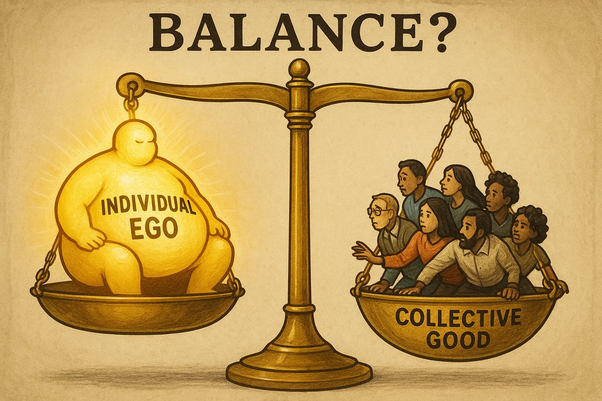
People once had to hunt in order to have something to eat, grow vegetables and fruits, build homes, sew clothes, and more. Every person did everything. Later, we developed an understanding that it was better to trade. We each specialized in certain fields and complemented each other’s deficiencies. Today, the ego has reached the sky in its proportions, and people want to swallow everything for themselves, to exploit everyone for their own enjoyment by any means. What will happen tomorrow? Can we analyze trends and preemptively treat the blows?
We saw how the economic crisis of 2008 led to people taking to the streets globally. They demanded justice, equality, and ultimately social balance. This is not new, of course. In our subconscious, we have always known that balance and reciprocity are positive, but narrow egoism pushed us to take endlessly for ourselves, i.e., to treat our connections with others as opportunities for control, to build our success on the ruin of others, and sometimes even to draw pleasure from others’ suffering. Whether or not it is pleasant to face it, human nature makes us compare ourselves to one another, and to wish failure upon everyone in order to feel our own self-worth.
On one hand, the ego is a growth engine. Without it, we would not have left the caves, developed social life, science, and culture. Thanks to the ego, we have competition, which refines our achievements and capabilities. On the other hand, there is a turning point, that if passed, the power of the ego becomes incredibly destructive.
Clarifying this boundary between good and bad ego stands before us as our generation’s principle task. The more accurately we make distinctions, the more we will save suffering, crises, wars, and disasters.
The nature around us develops as an integral system. Each element has its own seemingly egoistic impulses, but nature arranges them all into a single tapestry based on connection between opposites, complementarity, and reciprocity. Our body also works this way. If a particular cell in the body loses its sense of the system and begins to take endlessly from its environment, it is cancer, which is the disease that symbolizes the root of all problems in modern society more than any other.
How should social balance look? What does it mean to maintain balanced receiving and giving on the human level? These are big questions.
The 20th century presented two extremes, two opposing socio-economic approaches that both turned out to be unbalanced: the Russian approach, which suppressed the private ego by force, ended up collapsing; and the American approach that let the ego run wild without limits is also collapsing before our eyes, year after year.
The integral approach, the ideas of which are presented here, speaks of balance between the private ego and the good of the collective. It offers a method for progress to the next evolutionary stage of greater interdependence and interconnectedness, and emphasizes that we can fulfill the demand for equality and social justice, on condition that individual and collective are of equal importance. In such a reality, the balance between everyone will be defined as an overarching goal, as the outcome to strive for in every account: economic, social, and personal.
Indeed, it is a tremendous perceptual revolution. It will require a change in human nature and in the perception of the connection between the individual and society. Such an upgrade is possible only if we decide together to embark on a deep educational and cultural process that encompasses the whole of human society, with the aim of building a feeling and an understanding that the good of the individual and the good of the collective are truly one.
Until now, we could not approach such a balance because there was no clear recognition that the ego’s intensification is destroying us. Today, all the relationships we have built throughout history are falling apart one after another. The connections between people, sectors, and nations are becoming terrible and dreadful. We live inside one big ego bubble, which at any moment can explode, shattering us all with it.
We can particularly feel this problem here where I live, in Israel. Outside, we are surrounded by haters. Inside, we are divided and conflicted. We each pull for ourselves as much as possible, without any consideration for others. Such an egoistic approach runs completely contrary to our nation’s roots.
Originally, we became a nation based on the idea that “all of Israel are friends,” i.e., that we are guarantors for one another, and our unity should cover all of our differences. For our forefathers, “Love your neighbor as yourself” was the rule of rules, the code for optimal connection between people. Then, we experienced a leap of the human ego, and the nation shattered into fragments. After 2,000 years of wandering among the nations, today we need to start shaping our nation in an integral manner, i.e., in a way that will demonstrate the code of the new life. This will solve the problems among us and also bring sympathy and support from all nations, including our greatest haters.
The more we invest in this, the more we will discover within society an inner power of unification, connection, mutual guarantee, and reciprocity. It will be a tremendous power that we have never felt before in our lives. The power of a healthy body stems from the fact that its cells and organs are integrally connected, synchronized, and balanced. Then, instead of feeling tired, drained, and sick, we will feel like young people who are full of strength, desires, and abilities. Everything is open before us, and we have the ability to go from strength to strength. Additionally, the balance that we can generate among us will bring about an overall balance in the broader system of nature, the very system that we currently introduce several disruptions into.
I will conclude this idea here with words that were written in the 1940s, in the hope that we will finally begin to internalize them:
“That each and every individual will understand that his own benefit and the benefit of the collective are one and the same, and by this, the world will come to its full correction.” – Kabbalist Yehuda Ashlag (Baal HaSulam), “Peace in the World.”
Based on “New Life” episode 52 with Kabbalist Dr. Michael Laitman. Written/edited by students of Kabbalist Dr. Michael Laitman.
Posted on Facebook, Instagram, LinkedIn, Medium, Twitter X, YouTube, Quora