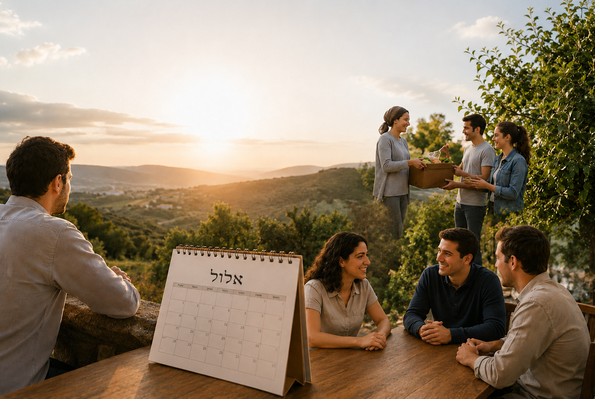
Behind the Jewish calendar and each of the Jewish holidays lies a deep inner meaning that plays out at the level of the desires and thoughts within a person who makes spiritual progress. Each calendar date symbolizes a stage in the developmental journey we are meant to undergo until we reach a state of complete connection and love, i.e., a state of adhesion and homeostasis with the source upper force of love and bestowal that is also called “God,” “Nature,” “the Creator” and several other names. Each calendar date offers a glimpse into the spiritual message embedded in the roots of the nation, a message that can heal the ailments and crises emerging in Israel and throughout humanity.
As for the month of Elul, it signifies an inner state at the beginning of a collective process of self-examination.
We enter a period in which we examine ourselves and begin to feel the extent to which we are governed by the ego, i.e., the desire to enjoy for self-benefit alone at the expense of others and nature. At the same time, this is a period in our inner spiritual development when we have already developed an ability to identify it and define this ego as evil, and it is also called “the evil inclination.”
The evil inclination becomes revealed precisely when we start trying to draw closer to each other. Then, we discover how unwilling we are to come closer together. This is how we begin to recognize our egoistic nature. Although this is a revelation of evil, it is actually a joyful discovery, because we uncover the evil within us through our yearning for goodness. We aspire to connect and then realize that we are unable to do so. This is already progress, a stage known as the recognition of evil. It is like diagnosing an illness in order to heal it.
Following the recognition of evil comes the stage of “turn away from evil and do good.” We decide to rid ourselves of the evil inclination and become connected to each other. This decision leads us into a process called Selichot (prayers for forgiveness) or self-examination. From this process, we can eventually arrive at Rosh Hashanah. In other words, we reach the determination that we want a new life in the new year, we desire a genuine change.
The name Elul is derived from the initials of the phrase “Ani LeDodi VeDodi Li” (“I am my Beloved’s and my Beloved is mine”). The meaning of this expression is that we long for the revelation of the upper force of love and bestowal, and we begin to feel that we receive support from it, opportunities for connection and similar forms of assistance. This is how we can already get a glimpse of the path ahead and consciously progress toward the realization of the purpose of creation. For this reason, Elul is a time of great joy.
The essence of forgiveness during Elul is in recognizing the contrast between ourselves and the overall system of nature, which is built upon perfect connection among its parts and remarkable harmony. Nature functions like a single body, whose parts exist in mutual support and cooperation in order to sustain the whole.
We see how far we, as human beings, are from such a relationship with one another. Instead, we often behave like cancerous cells within the general body, causing harm to all levels of reality, to the inanimate, vegetative, and animate realms, as well as to other human beings.
When we truly begin to feel the gap between our own nature, which seeks only to receive for itself, and the nature of the upper force, which is entirely love and bestowal, we begin to grasp the true meaning of forgiveness.
Forgiveness means that from this point forward, we commit ourselves to rising above evil and beginning our lives with a new orientation, toward goodness, connection, and unity.
Based on “New Life 193 – The Holidays of Israel” with Kabbalist Dr. Michael Laitman. Written/edited by students of Kabbalist Dr. Michael Laitman.
Posted on Facebook, Instagram, LinkedIn, Medium, Quora, Twitter X, YouTube