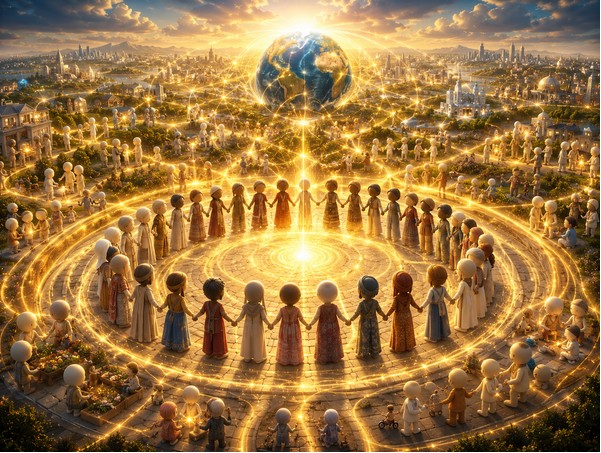
When we look at the natural world around us, we see that it is entirely unified. All its parts work together harmoniously to form a single whole. Only among us, the human species, is everything fragmented. The ego that grows within each individual prevents us from building anything together. The world is becoming increasingly interconnected, and everyone is becoming increasingly dependent on everyone else. Yet at the same time, each person sees only themselves more and more. This is the root of all the crises and conflicts afflicting the world, from international tensions and social divisions to personal relationships.
Our future and prosperity depend on learning to connect with one another like different parts of the same system, like organs within a single body. We must become like one family, whose members treat one another with consideration, assistance, and support. Naturally, the process of global connection begins with the basic unit of society: the family.
According to the biblical story, Eve was the first to recognize how narrow egoism, i.e., the desire to enjoy at the expense of others, which was symbolized by the serpent in the story, destroys human relations. It creates conflict between husband and wife. It pushes each person into their own corner, into their own self-interest, and seeks to tear the relationship apart. From that point onward, building a family bond required effort. Unlike animals, for whom such connections come naturally, human beings must work hard against the ego that constantly comes between them. Eve felt a need to repair the damaged relationship, and the next figure who continued in this direction was Sarah.
The sources tell us that Abraham taught the men while Sarah taught the women how to build healthy relationships, how to rise above the ego and live according to values of kindness, love of others, unity, and mutual complementarity. The community of their students gradually built family units and, over time, became the people of Israel, as Maimonides describes in The Book of Knowledge. Abraham was told, “Whatever Sarah tells you, listen to her voice.” Through her dedication to education and guidance, a community emerged that aspired to live like one family. The matriarchs who followed each contributed to the development of harmonious human connection in their own way, and the next prominent figure was Miriam the Prophetess.
Quietly, yet with greater power than any man, Miriam helped Moses and Aaron lead the children of Israel out of Egyptian bondage. She inspired women and guided them to a new future. In the inner meaning of the Exodus story, the force that enslaves people is the same narrow egoism that drives individuals into conflict with one another.
A prophet or prophetess is a person who perceives the general force operating throughout nature—the one force underlying reality—and thereby understands how the entire mechanism of existence functions. Such people perceive how this single force develops all parts of creation toward a state of perfect connection. This includes the still, vegetative, animate, and human levels of nature. Miriam attained such a level of development, and from that perspective she helped her brothers build harmonious relationships among the people.
It is said that at Mount Sinai, the women supported the men and, in effect, compelled them to meet the condition set before them: “You must become responsible for one another, as one man with one heart, or this will be your burial place. Your ego will destroy you.” Through this feminine encouragement, the people received the Torah, whose inner essence contains the instruction for developing healthy relationships with others and with all of creation.
This theme recurs throughout history. At critical crossroads, on the brink of breakdown, the feminine force stepped forward and guided the people toward the right path. Every year we remember Queen Esther, who instructed Mordecai: “Go, gather all the Jews together.” Indeed, through gathering and uniting, salvation came.
Another outstanding biblical figure is Deborah the Prophetess. During the period of the Judges, she judged the people and even led the struggle against Sisera. Deborah stood on a higher spiritual level than any of the men of her generation; there was no one wiser or more righteous than she. The generation was divided, and the correction required first exposing the evil within that division. In her song, Deborah praises the tribes that participated in the collective effort and criticizes those that did not, thereby separating themselves from the mutual responsibility that should exist among the people.
Today, sadly, we are very far from feeling that we are all brothers and sisters. Disrespect, rejection, and sometimes even hatred have reached extreme levels. One might say, “There’s nothing to be done, every nation is like this.” But our nation was founded on the principle of love for others and once lived as a family, until unfounded hatred destroyed that unity.
Today, as the world is being torn apart by deteriorating human relationships and our common home is under threat, we must return to our true foundations and set an example of connection above all differences. The longer we delay, the more hostility toward us will grow, making life increasingly difficult.
And here, only the feminine force can rise up and declare: “Enough! Life requires us to be connected!”
If more and more women unite with the intention of inspiring the men to do the same, the men will not be able to remain indifferent. Such is the law of nature: women awaken the need, and men work to fulfill it. This partnership between the feminine and masculine forces, expanding in ever-widening circles, can give birth to a new life for us all.
Based on “New Life 165 – Outstanding Women in Jewish Culture, Part 1” with Kabbalist Dr. Michael Laitman. Written/edited by students of Kabbalist Dr. Michael Laitman.
Posted on Facebook, Instagram, LinkedIn, Medium, Quora, Twitter X, YouTube