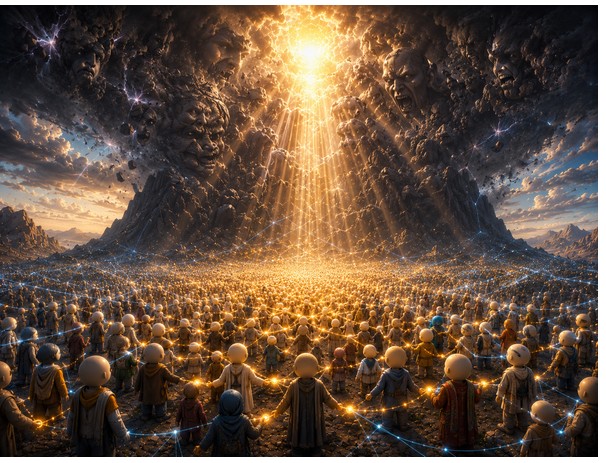
The story of Mount Sinai raises an important question: what kind of interaction existed there between people, and what can we learn from it in relation to what is happening today in Israel and throughout the world? It points to the next stage in human evolution and to a future that is rapidly approaching.
Our story begins in ancient Babylon. Abram son of Terah, a persistent Babylonian researcher, discovered that nature is an integral network governed by a single force. To align with the unity of nature, humanity too must become united. Therefore, Abraham taught kindness and love of others. “We must live as one family,” he told everyone. Thousands and tens of thousands joined his idea, as Maimonides describes in The Book of Knowledge, and from them the nation later developed.
This group passed through a chain of states, and in each one it faced the same task: to preserve unity and build a society that would function like a family. Every event that befell the group was treated as an opportunity to increase their connection. Every egoistic eruption that threatened to separate people was regarded as a help against itself, a lever for increasing unity. This is how the group advanced from one state to another, growing stronger and more cohesive on its path to complete integral connection. This, in essence, is the whole Torah in a nutshell, while everything else is an elaboration of it.
Abraham, Isaac, and Jacob symbolize the “three lines” that exist within this process of connection: Abraham represents the right line, Isaac the left line, and Jacob the middle line. In simple terms, the process can be described as follows: first, I try to relate positively to another person (right line); then I discover that I am incapable of doing so, that I am driven by selfishness (left line); and finally, above the selfishness that has been revealed, I ask for the strength to overcome it and connect through love nevertheless (middle line).
During the Egyptian exile, Pharaoh ruled over the people of Israel. Spiritually speaking, this means that the intensification of narrow egoism—the desire to enjoy for self-benefit alone at the expense of others—harmed the bond between them. Eventually, when they saw how the force of separation enslaved them and threatened to destroy them, they were given the opportunity to escape from it, i.e., to leave Egypt.
The egoism that became revealed to them in Egypt, i.e., feelings of rejection, distance, criticism, and contempt, served as preparation for the event at Mount Sinai. It is also notable that the Hebrew word for “mountain” (“Har”) is associated with thoughts and reflections (“Hirhurim”), while the word “Sinai” is associated with hatred (“Sinah”).
At Sinai they were presented with a condition: Could they rise above their egoism? Could they positively connect despite everything, and become as one? Could they discover a state as if there were no differences between them, like drops of water gathering into a cup and becoming a single uniform liquid? Were they prepared to be guarantors for one another? To care only for others? To become a society in which all are friends, equal, brothers, and beloved companions? If so, they would be worthy of receiving the Torah, which is a higher light, a special force that would enable such connection.
The first principle of integral connection is: “Do not do to your friend what is hateful to you.” One must refrain from harming another, even in thought. The test here is that what you would not want others to think about you or do to you, do not think or do to them. It is like trying on a shirt to see how it fits.
The second principle is more advanced: “Love your neighbor as yourself.” We need to feel the hearts of others, include ourselves in their desires, and place ourselves in their service. In other words, we should wish to exist solely for the benefit of others.
At first glance, these conditions and principles seem unrealistic and contrary to human nature. Especially today, in an age of intensified egoism, it is difficult to imagine how anyone could fulfill them. Yet this is precisely the direction toward which nature’s evolutionary forces are guiding humanity. It is no coincidence that the world is becoming increasingly interconnected and interdependent. This is nature’s way of showing that, from the perspective of the system, we are all parts of one body, and complete connection among all people is an unavoidable necessity.
Returning to Mount Sinai, the law of development in nature operates gradually. First, there had to be a small group capable of realizing integral connection within itself, so that eventually this model could spread to all of humanity. As the Bible states: “You shall be to Me a kingdom of priests and a holy nation.” This gathering began in Abraham’s time and continued throughout history. Anyone drawn to the spiritual ideal joined the nation, regardless of ancestral connections. Some notable examples were Ruth the Moabite, from whom King David descended, and also Rabbi Akiva was the son of converts, Onkelos was a convert, and the list goes on.
“And Israel camped there opposite the mountain,” says the verse describing Mount Sinai. The sages explain that the verb is written in the singular because the people felt themselves to be “as one man with one heart.” As a result, the people declared, “We shall do and we shall hear.”
In simple terms, their common desire to break free from narrow egoism reached such intensity that it brought about a collective elevation. People stopped feeling only themselves and began to feel everyone connected together. Such a connection resembled, to some degree, the general force of nature—also called God, the Creator, or the One Force—and therefore this force was revealed among them as a quality of mutual bestowal and goodness that filled them for a period of time.
The Torah that was given contains a concealed method for the complete correction of the egoistic nature of the human being, a method that is studied in the wisdom of Kabbalah. Broadly speaking, human nature contains 613 desires, all governed by an egoistic intention, which is the desire to use others for one’s own benefit. These desires must be revealed and corrected, meaning that the intention behind their use must be transformed into one that benefits others. Each such transformation is called the fulfillment of a Mitzva (commandment), which is why there are 613 Mitzvot (commandments), or in other words, 613 corrections of intention.
“The Israeli nation had been constructed as a sort of passageway by which sparks of refinement would flow onto the entire human race throughout the world… until they develop to such an extent that they can understand the pleasantness and tranquility that are found in the kernel of love of others.”
– Kabbalist Yehuda Ashlag (Baal HaSulam), “The Arvut [Mutual Guarantee].”
For two thousand years, unfounded hatred has brought ruin upon us, yet reality now compels us to regain awareness: Who are we? What kind of world do we live in? What is the greater purpose? Israel and the world are falling apart through ego-driven conflicts, and hatred toward us continues to intensify. This will continue until we once again follow Abraham’s path and become the pioneering force in correcting human nature.
We have the opportunity to set a positive example and lead humanity to an integral, harmonious, and peaceful connection, in unity and love. It is a connection that will expand the boundaries of our narrow perception and bring us into a spiritual dimension beyond time, space, and motion. It is a state of harmony with all of nature, of adhesion with the perfection and eternity inherent in creation.
I wish us great success in this fateful endeavor.
Based on “New Life 158 – The Ten Commandments, Part 1” with Kabbalist Dr. Michael Laitman. Written/edited by students of Kabbalist Dr. Michael Laitman.
Posted on Facebook, LinkedIn, Medium, Quora, Twitter X, YouTube