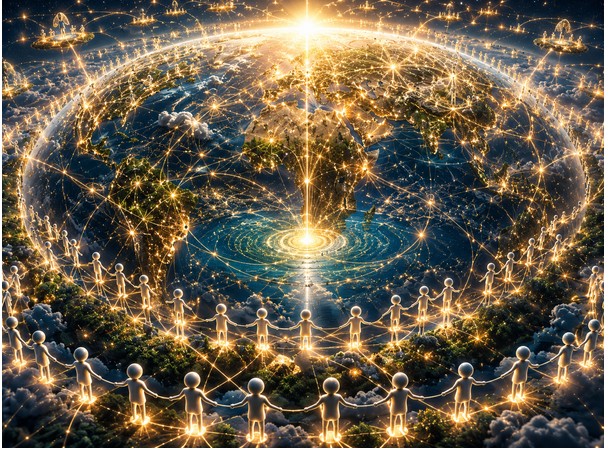
Modern society is built on egoism, i.e., the desire to enjoy for self-benefit at the expense of others. From childhood, people are taught that success means getting ahead of others, standing above them, earning more, achieving more, and securing a better position than everyone else. The greater a person’s egoism, the greater the perceived opportunity to succeed.
Yet this egoistic system is reaching its limit.
Humanity has arrived at a state of exhaustion. After centuries of pursuing personal gain, power, wealth, status, and achievement, we realize that such fulfillments are fleeting and do not truly fulfill us. Accordingly, the world has become burned out from egoism. It can no longer continue advancing along the same egoistic lines of success. The dreams that once motivated humanity are gradually fading, and many no longer believe that more success, wealth, or power will solve their problems.
In such a state, more and more people face a fundamental question about our lives: How can we continue to exist?
The answer is in a completely new developmental direction. Instead of valuing competition and separation, we must learn to value connection. Humanity’s future depends not on how successfully we compete with each other, but on how successfully we connect with each other.
In such a connection, we will discover new goals, new possibilities, and even a new perception of reality. What today appears to be an exhausted and fragmented world will reveal itself as a living interconnected and interdependent system through which we can discover life’s meaning and purpose.
This principle applies not only to humanity as a whole but also to our personal relationships. Even questions about how friendships can be preserved throughout life can become answered by a fundamental shift in perception.
We need to understand that whatever negativity we see in others is a reflection of an inner aspect of ourselves. There is nothing inherently bad outside of us. The flaws, faults, and shortcomings we perceive in others point to qualities that require correction in our own perception.
Therefore, the work is never to correct others. It is always to correct ourselves.
As we gradually transform our inner qualities, our view of the world also begins to change. What once appeared hostile begins to appear benevolent. What once seemed broken begins to reveal harmony. What once looked like a world filled with enemies begins to look like a world filled with opportunities for connection.
In Kabbalistic terms, this transformation is the difference between heaven and hell.
Heaven is not a place somewhere beyond this life. It is a state of perception. If we invert the negativity inside us, we begin to experience reality as harmonious, beautiful, and whole. We discover that heaven was always present; only our perception prevented us from seeing it.
Conversely, if we do not change our inner qualities, the world continues to appear hostile and painful. The hell we experience is not outside of us but within us.
This is why judging others is unproductive. If we see hell in other people, then that hell exists within us. The solution is not to change others but to change ourselves. The moment we correct our own perception, we begin to see a different reality.
Humanity’s path forward is that we each shift our focus from correcting others to correcting ourselves, from competition to connection, and from division to unity. By doing so, we discover not only better relationships but an whole new world.
Based on KabTV’s “News with Dr. Michael Laitman” with Kabbalist Dr. Michael Laitman on May 8, 2026. Written/edited by students of Kabbalist Dr. Michael Laitman.
Posted on Facebook, Instagram, LinkedIn, Medium, Quora, Twitter X, YouTube