|
Getting your Trinity Audio player ready...
|
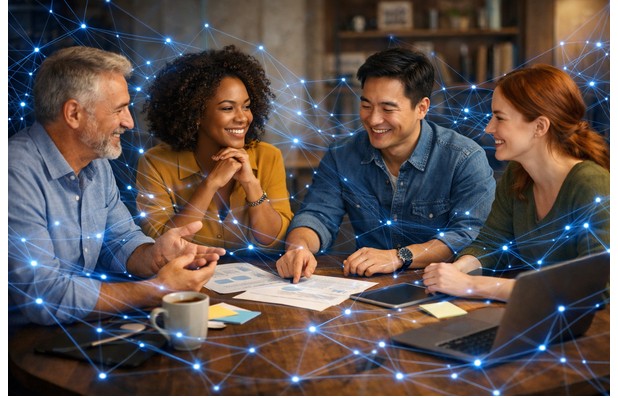
The integral approach to organizational development aims to transform relationships within an organization into those of a good, connected, and warm family. Why is this not only profitable but truly essential? It stems from the evolutionary trend we are part of, and from the collective mind that emerges through deep human connection.
From one generation to the next, the world becomes increasingly interconnected. Whether we like it or not, we find ourselves as if in the same boat. We influence and depend on each other, and we are stuck together. Increased connectivity is simultaneously coupled with a continuously growing human ego, i.e., a desire to enjoy for self-benefit at the expense of others. We feel compelled to see ourselves as right, smarter, and more successful than others, often stepping on others to achieve personal success.
The contradiction between these two developmental directions—the world becoming integral and interconnected, and human nature becoming more egoistic and narrow—lies at the root of all the crises we see today in relationships. This applies internationally, socially, in business, within organizations, and also in personal life, relationships, and parenting. Modern individuals struggle to get along with those around them, which is a serious problem.
We will eventually be forced to learn how to connect harmoniously, like parts of a single integral system, or we will all sink. Organizations that develop such an ability among their personnel ahead of time will make great progress and breakthroughs. The integral method teaches how to do this in a step-by-step manner. Its implementation requires allocating fixed time slots in employees’ weekly and daily schedules, guided by experts. The goal is to build and maintain an integral atmosphere, a connected environment that provides everyone with positive examples of how to relate to one another.
Until a few decades ago, no one thought organizations needed to arrange picnics, vacations, fun days, gyms, and other modern perks for employees. We came to see that such events and activities are worthwhile because they bring tangible benefits, and employers profit more as a result. Integral organizational development is essentially a conscious step toward the next stage. There is no choice but to improve relationships between people in organizations. The more emotionally connected people are, the more productivity rises dramatically. Otherwise, they spend their time in conflict, trying to undermine one another, and the organization suffers greatly.
A Collective Mind
A new kind of connection between employees creates a collective mind, a collective intelligence in the integral organization. Through everyone’s effort to rise above their ego, a new common state is reached.
What does it mean to rise above each one’s personal ego?
Imagine a table in a typical meeting room. People sit around it discussing a certain topic. Each is focused on themselves, their own interests, promoting their opinion, and battling others. It is a familiar scene to see shouting, arguments, indifference, and disrespect at such times. They end up reaching a certain result, but at what cost?
Now imagine that the people in the room had undergone an integral developmental process and built a positive connection. In such a case, each person would view things not solely from their personal perspective, but from a broader collective view. Around that same table, they could achieve results at a much higher level. How much higher? It depends on the level of connection, the strength of the bond between the participants.
It is very important to understand that the more we rise above narrow self-interest, the more space is created for the discovery of new thoughts and emotions, and brilliant insights. The level of human connection determines the level of the collective mind that can emerge among them. Therefore, nothing will limit their development. When an organization reaches this new level of capability, non-integral organizations will struggle greatly to compete with it.
A Help Against Itself
From a broader perspective, what lifted humans out of the animal world was the ego’s growth. since we are egoistic and want more and more, we developed an intellectual capacity. This led humanity to great achievements, but also to mistakes. Why do animals not make mistakes? It is because they act according to their innate instincts; they are directly connected to nature.
What the integral method does, in this context, is reconnect humans with nature, but at a higher level. If the ego distanced us from nature, then connection between us above the ego leads to a discovery of a higher level within nature. Together, we rise to a stage of development filled with the intelligence of nature, the intelligence that connects all of nature’s elements into a single integral system. Aligning our relationships with nature’s integrality fills us with higher emotion and understanding, and we stop making mistakes.
It is important to emphasize that the integral method does not cancel, erase, or suppress the ego. Instead, it teaches us how to use it as a lever. This is referred to in sources as “a help against it.” “Love covers all crimes” is the general formula of development. It means that as the ego appears in relationships, it creates opportunities to build even stronger integral connections. The “crimes,” the frictions, become the building blocks of the integral structure we create.
Eventually, we learn to become “as one man with one heart,” as a unified group, living in love. Then we understand why nature brought us out of it through the ego’s growth, and how we return to conscious connection with it through harmonious and peaceful relationships. The two systems of human egoistic nature and integral connection, which we integrate, together grant us a higher level of understanding and perception, which open up a new reality before us.
Based on “New Life 124 – Management and Leadership, Part 2” with Kabbalist Dr. Michael Laitman. Written/edited by students of Kabbalist Dr. Michael Laitman.
Posted on Facebook, Instagram, LinkedIn, Medium, Twitter X, YouTube, Quora